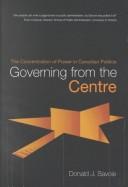
Governing from the Centre
0
0
As an Amazon Associate and affiliate partner, Menrva Books earns from qualifying purchases. Learn more
Author Description
Redefined during the past thirty years, the centre of government currently extends itself further than ever before. Central governmental agencies are 'where the rubber meets the road,' where public service meets politics, and policy becomes reality. So who's driving this car? Agencies such as the Privy Council Office, the Finance Department, and the Treasury Board exert their influence horizontally, deciding how policy is made and how money gets spent. According to Donald Savoie, these organizations, instituted to streamline Ottawa's planning processes, instead telescope power to the Prime Minister and weaken the influence of ministers, the traditional line departments, and even parliament, without contributing to more rational and coherent policy-making. Indispensable reading for students of politics, public policy, and public administration, Ottawa watchers, journalists, lobbyists, and civil servants who want to know what is really going on.
Menrva's Summary
THE THESIS
The centre of government has expanded its influence significantly over the past thirty years, becoming the primary locus of policy-making and resource allocation. Central agencies like the Privy Council Office, Finance Department, and Treasury Board now wield considerable power, shaping how policies are formed and funds are disbursed. Donald Savoie argues that these powerful central bodies, intended to rationalize planning, paradoxically concentrate power within the Prime Minister's Office, diminishing the roles of individual ministers, line departments, and Parliament. This concentration of power, he contends, does not necessarily lead to more rational or coherent policy outcomes.
THE SCOPE MAP
- Analysis of the historical evolution and expansion of central governmental agencies.
- Examination of the influence exerted by specific agencies such as the Privy Council Office, Finance Department, and Treasury Board.
- Discussion of how central agencies impact policy-making processes and budgetary decisions.
- Critique of the concentration of power within the Prime Minister's Office.
- Assessment of the weakening influence of ministers, line departments, and Parliament.
- Evaluation of whether expanded central control leads to more rational and coherent policy-making.
- Identification of the key stakeholders and audiences for this analysis, including students of politics, public policy, public administration, journalists, lobbyists, and civil servants.
THE AUTHORITY PERSPECTIVE
The book is presented as indispensable reading for those involved in or observing Canadian politics and public administration. Its analysis of the expanding role of central government agencies and the concentration of power is framed as essential for understanding the inner workings of government. The author's critique suggests a focus on the structural and political dynamics that shape policy outcomes in Ottawa. The description implies a detailed examination of bureaucratic power and its implications for democratic governance.
Page Count:
440
Publication Date:
1999-01-01
ISBN-10:
0802082521
ISBN-13:
9780802082527
Art
Science
Non-Fiction
Politics
Government
Public Administration
Community Tags
Similar Books