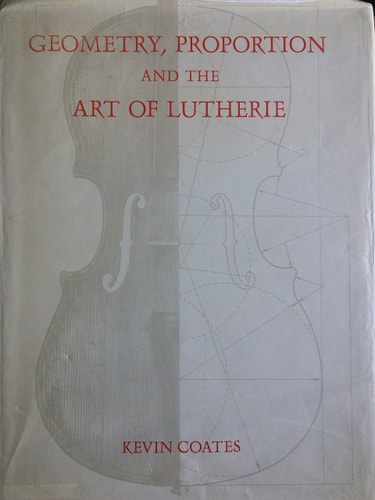
Geometry, Proportion, and the Art of Lutherie
0
0
As an Amazon Associate and affiliate partner, Menrva Books earns from qualifying purchases. Learn more
Author Description
This study explores a controversial aspect of Western musical instrument design, establishing beyond question that the familiar stringed instrument outlines developed between the sixteenth and eighteenth centuries were not arbitrary, intuitive shapes drawn within acoustically efficient frameworks, but were designs following a profoundly considered manipulation of plane geometry and numerical proportion. The central core of the work is the detailed step-by-step design analysis of thirty-three important historic instrument examples covering all main categories of stringed musical instruments of the period.
Menrva's Summary
THE THESIS
This work investigates whether the iconic outlines of Western stringed instruments from the sixteenth to eighteenth centuries were the result of arbitrary intuition or the product of rigorous geometric and numerical planning. Kevin Coates, a researcher and practitioner in the field of lutherie, presents a systematic analysis of historical instrument design. He argues that the aesthetic and structural forms of these instruments were governed by a deliberate application of plane geometry and mathematical proportion rather than mere acoustic trial and error.
THE SCOPE MAP
What You Will Find
- Detailed design analysis of thirty-three significant historical stringed instruments.
- Examination of the relationship between plane geometry and instrument silhouette.
- Application of numerical proportion theories to lutherie practices.
- Comparative study across various categories of stringed instruments from the 16th to 18th centuries.
THE AUTHORITY PERSPECTIVE
Experts and luthiers regard this text as a foundational reference for understanding the mathematical underpinnings of classical instrument design. Readers frequently note the technical density of the analysis, which requires a foundational knowledge of geometry to fully appreciate the author's conclusions.
Page Count:
224
Publication Date:
1985-07-11
Publisher:
Oxford University Press
ISBN-10:
0198161395
ISBN-13:
9780198161394
Music
History
Design
Geometry
Art History
Craftsmanship
Proportion Art
Community Tags
Similar Books














