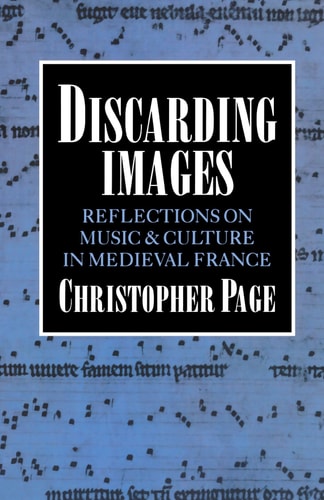
Discarding Images: Reflections on Music and Culture in Medieval France
0
0
As an Amazon Associate and affiliate partner, Menrva Books earns from qualifying purchases. Learn more
Author Description
For many centuries, the Western imagination has pictured the medieval period as a kind of odyssey: a journey that took humankind to a strange country and ended in the Renaissance with its homecoming and the restoration of its inheritance. In this stimulating and provocative book, Christopher Page, Director of the acclaimed early music vocal group Gothic Voices, explores the kinds of generalizations that we habitually make about "the Middle Ages" and which, whether we know it or not, sustain the false image of a medieval odyssey. In chapters that proceed chronologically from the thirteenth to the fifteenth century, he examines what we suppose to be the serenity of medieval reflection on such matters as the "numerical" explanation of musical beauty, and he questions the modern tendency to regard Ars antiqua motets as music for "an intellectual elite." Turning to the Ars Nova and beyond, he discusses the relation between fourteenth century innovations and contemporary science. A final chapter explores the powerful influence of Johan Huizinga's classic The Waning of the Middle Ages upon musicology. Page's lively prose is full of provocative ideas, and is enriched by an uncommonly deep experience of medieval music.
Menrva's Summary
THE THESIS
This book investigates the validity of long-standing historical generalizations regarding the Middle Ages and their impact on our modern understanding of medieval music and culture. Christopher Page, a distinguished scholar and director of the early music ensemble Gothic Voices, utilizes his extensive practical experience with medieval performance to challenge the narrative of the Middle Ages as a mere precursor to the Renaissance. By analyzing the intersection of musical theory, contemporary science, and historical reception, he deconstructs the myths surrounding medieval intellectual life and artistic production.
THE SCOPE MAP
What You Will Find
- Chronological analysis of musical and cultural shifts from the thirteenth to the fifteenth century.
- Critical examination of the 'numerical' explanations of musical beauty prevalent in medieval thought.
- Re-evaluation of the Ars antiqua and Ars Nova periods in the context of contemporary scientific innovation.
- A focused critique of Johan Huizinga’s influence on modern musicological interpretations of the late medieval period.
THE AUTHORITY PERSPECTIVE
Experts and musicologists frequently cite this work for its ability to bridge the gap between performance practice and academic historical inquiry. Readers often note the density of the prose, which demands a high level of engagement with both musical theory and historiographical debate.
Page Count:
256
Publication Date:
1993-09-16
Publisher:
Oxford University Press
ISBN-10:
0198163460
ISBN-13:
9780198163466
Non-Fiction
Music
History
Music French
Musicology