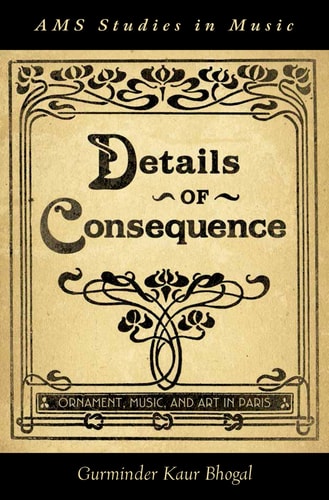
Details of Consequence: Ornament, Music, and Art in Paris
0
0
As an Amazon Associate and affiliate partner, Menrva Books earns from qualifying purchases. Learn more
Author Description
Details of Consequence examines a trait that is taken for granted and rarely investigated in fin-de-siècle French music: ornamental extravagance. Considering why such composers as Claude Debussy, Maurice Ravel, Gabriel Fauré, Igor Stravinsky, and Erik Satie, turned their attention to the seemingly innocuous and allegedly superficial phenomenon of ornament at pivotal moments of their careers, this book shows that the range of decorative languages and unusual ways in which ornament is manifest in their works doesn't only suggest a willingness to decorate or render music beautiful. Rather, in keeping with the sorts of changes that decorative expression was undergoing in the work of Eugène Grasset, Pierre Bonnard, Henri Matisse, and other painters, composers also invested their creative energies in re-imagining ornament, relying on a variety of decorative techniques to emphasize what was new and unprecedented in their treatment of form, meter, rhythm, melody, and texture. Furthermore, abundant displays of ornament in their music served to privilege associations that had been previously condemned in Western philosophy such as femininity, sensuality, exoticism, mystery, and fantasy. Alongside specific visual examples, author Gurminder Kaur Bhogal offers analyses of piano pieces, orchestral music, chamber works, and compositions written for the Ballets Russes to highlight the disorienting effect of musical experiments with ornament. Acknowledging the willingness of listeners to borrow vocabulary from the visual arts when describing decorative music, Bhogal probes the formation of art-music metaphors, and studies the cognitive impetus behind tendencies to posit stylistic parallels. She further illustrates that the rising expressive status of ornament in music and art had broad social and cultural implications as evidenced by its widespread involvement in debates on French identity, style, aesthetics, and progress. Drawing on a range of recent scholarship in the humanities a
Menrva's Summary
THE THESIS
This book investigates the role of ornamental extravagance in fin-de-siècle French music, questioning why prominent composers utilized decorative techniques to signal innovation and challenge traditional aesthetic hierarchies. Author Gurminder Kaur Bhogal, a scholar of musicology, synthesizes music theory with visual art history to argue that ornament was not merely superficial but a deliberate tool for re-imagining musical form, rhythm, and texture. By examining the works of composers such as Debussy, Ravel, and Satie alongside the visual art of Matisse and Bonnard, the text posits that musical ornament served as a vehicle for exploring themes of femininity, exoticism, and cultural identity during a period of significant artistic transition.
THE SCOPE MAP
What You Will Find
- Comparative analysis of musical compositions and visual art movements in fin-de-siècle France.
- Technical examination of how ornament influences form, meter, rhythm, melody, and texture in piano, orchestral, and chamber works.
- Exploration of the cognitive and linguistic frameworks used to create art-music metaphors.
- Investigation into the social and cultural implications of decorative expression regarding French identity and aesthetic progress.
THE AUTHORITY PERSPECTIVE
Experts recognize this work as a significant contribution to interdisciplinary musicology, noting its success in bridging the gap between visual art theory and musical analysis. Scholars frequently highlight the text's rigorous approach to examining how decorative elements function as structural components rather than mere embellishments.
Page Count:
368
Publication Date:
2013-10-09
Publisher:
Oxford University Press
ISBN-10:
0199795053
ISBN-13:
9780199795055
Music
Musicology
Art History
Aesthetics
Art And Music
Music French
French History
Community Tags
Similar Books