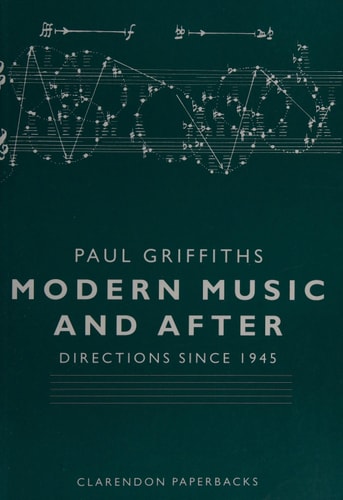
Modern Music and After: Directions Since 1945
0
0
As an Amazon Associate and affiliate partner, Menrva Books earns from qualifying purchases. Learn more
Author Description
The rich dynamic of modern music stands as a continual source of intrigue and curiosity, not only to the listening public, but to the artists who create the music as well. The first edition of Modern Music: The Avant-Garde Since 1945 addressed this phenomenon, offering a keen examination of how important composers have responded to the constant flux of their cultural environs, both socially and technically. Now in a fully revised new edition, Modern Music and After: re-establishes Paul Griffiths's survey as the definitive study of music since the Second World War.Divided into three phases, Modern Music and After defines the distinct attitudes and ideals that characterized and shaped music over the last fifty years. The first phase, lasting until approximately 1960, was governed by hopes for a steady progressive change in the nature of music, in the routines of composing, and in music's place within society. Because these hopes were widely shared, they encouraged an uncommon profusion of alliances. Eventually, differences among composers began to overwhelm the mutualities, and the single history of the late 1940s and 1950s was succeeded in the next two decades by a knotted convergence of styles and objectives. The third phase examines the manifestation of modern music's confluted growth, emphasizing the extreme diversity of the contemporary scene of the 1980s and 1990s.From the beginning, the disruptions of the war and the struggles of the ensuing peace were reflected in the music of the time: in Pierre Boulez's radical re-forming of compositional technique, in John Cage's move into zen music, in Milton Babbitt's settling of the serial system, and in the work and theories of Dmitry Shostakovich, Karlheinz Stockhausen, Luigi Nono, Iannis Xenakis, and Luciano Berio. The initiatives of these composers and their contemporaries opened prospects that have continued to unfold. This constant expansion of musical thinking since 1945 has left us with no single history of music
Menrva's Summary
THE THESIS
This book investigates the evolution of Western art music from 1945 to the late 1990s, questioning how composers navigated the cultural and technical shifts of the post-war era. Paul Griffiths, a noted music critic and historian, utilizes a chronological framework to categorize the development of avant-garde music into three distinct phases. By analyzing the works of influential figures such as Boulez, Cage, and Stockhausen, he argues that the post-war period moved from a unified hope for progressive change toward a complex, pluralistic landscape of diverse musical styles. The text provides a rigorous examination of how social disruptions and technological advancements fundamentally altered the trajectory of modern composition.
THE SCOPE MAP
What You Will Find
- A tripartite historical analysis of musical development from 1945 through the 1990s.
- Detailed examinations of serialism, aleatory music, and electronic composition techniques.
- Case studies of key composers including Pierre Boulez, John Cage, Milton Babbitt, and Karlheinz Stockhausen.
- A thematic exploration of the shift from post-war optimism to the stylistic fragmentation of the late 20th century.
THE AUTHORITY PERSPECTIVE
Experts and musicologists frequently cite this work as a foundational survey for understanding the complexities of the post-war avant-garde. Readers often note the academic density of the prose, which provides a comprehensive and authoritative overview of a challenging musical era.
Page Count:
392
Publication Date:
1996-04-11
Publisher:
Oxford University Press
ISBN-10:
0198165110
ISBN-13:
9780198165118
Music
Music theory
Music History
Community Tags
Similar Books