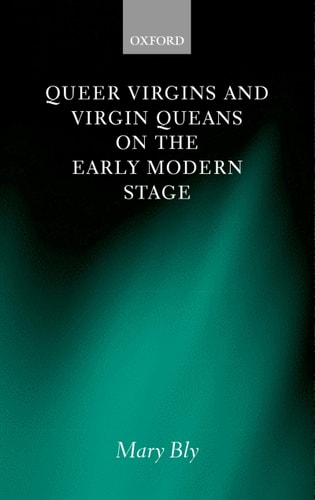
Queer Virgins and Virgin Queans on the Early Modern Stage
0
0
As an Amazon Associate and affiliate partner, Menrva Books earns from qualifying purchases. Learn more
Author Description
Queer Virgins and Virgin Queans looks at the early modern theater through the lens of obscure and obscene puns--especially "queer" puns, those that carry homoerotic resonances and speak to homoerotic desires. In particular, it resurrects the operations of a small boys' company known as the first Whitefriars, which performed for about nine months in 1607-8. As a group, the plays performed by this company exhibit an unusually dense array of bawdy puns, whose eroticism is extremely interesting, given that the focus of eros is the male body. The laughter recoverable from Whitefriars plays harnesses the pun's inherent doubleness to homoerotic pleasure; in these plays, 'the bawdy hand of the dial' is always 'on the pricke of noone'.Mary Bly's analysis depends on the nature of punning itself, and the inflections of language and the creativity that marked Whitefriars punsters, with special emphasis on the effect of puns on an audience. What happens to audience members who sit shoulder to shoulder and laugh at homoerotic quibbles? What is the effect of catching a queer pun's double meaning in a group rather than while alone? How can we characterize those auditors, within the convoluted, if fascinating, theories of erotic identity offered by queer theorists?
Menrva's Summary
THE THESIS
This work investigates how the linguistic mechanics of bawdy puns in early modern theater functioned to encode and facilitate homoerotic expression within the specific cultural context of the Whitefriars boys' company. Mary Bly, a scholar of early modern literature, utilizes a framework rooted in queer theory and linguistic analysis to examine how the inherent ambiguity of puns allowed playwrights and actors to navigate and subvert contemporary social norms. By focusing on the brief but prolific output of the Whitefriars company during 1607-1608, the author argues that these linguistic devices created a shared, subversive space for audiences to engage with homoerotic desire through collective laughter.
THE SCOPE MAP
What You Will Find
- Analysis of the 1607-1608 repertoire of the first Whitefriars boys' company.
- Examination of the linguistic structure of early modern puns and their double meanings.
- Theoretical application of queer theory to historical performance practices.
- Investigation into the social dynamics of audience reception and collective laughter in early modern theaters.
THE AUTHORITY PERSPECTIVE
Scholars frequently cite this text as a significant contribution to the study of early modern performance and the history of sexuality. Experts highlight the author's ability to bridge the gap between complex linguistic theory and the practical realities of historical theater audiences.
Page Count:
224
Publication Date:
2000-08-10
Publisher:
Oxford University Press
ISBN-10:
0198186991
ISBN-13:
9780198186991
Child Actors
Theater History
In literature
Literary Criticism
Queer Theory
Gender Studies
Community Tags
Similar Books