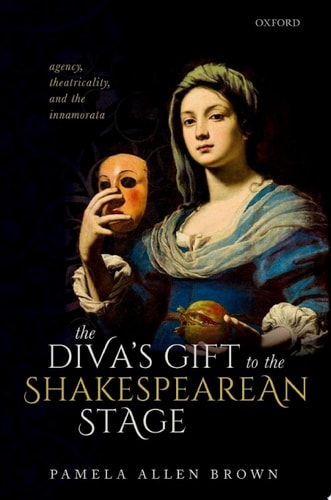
The Diva's Gift to the Shakespearean Stage: Agency, Theatricality, and the Innamorata
0
0
As an Amazon Associate and affiliate partner, Menrva Books earns from qualifying purchases. Learn more
Author Description
The Diva's Gift traces the far-reaching impact of the first female stars on the playwrights and players of the all-male stage. When Shakespeare entered the scene, women had been acting in Italian troupes for two decades, traveling in Italy and beyond and performing in all genres, including tragedy. The ambitious actress reinvented the innamorata, making her more charismatic and autonomous, thrilling audiences with her skills. Despite fervent attacks, some actresses became the first international stars, winning royal and noble patrons and literary admirers in France and Spain. After Elizabeth and her court caught wind of their success in Paris, Italian troupes with actresses crossed the Channel to perform. The Italians' repeat visits and growing fame posed a radical challenge to English professionals just as they were building their first paying theaters. Some writers treated the actress as a whorish threat to their stage, which had long minimized female roles. Others saw a vital new model full of promise. Lyly, Marlowe, and Kyd endowed innamorata parts with hot-blooded, racialized passions, but made them self-aware agents, not counters traded between men. Shakespeare, Jonson, Webster and others followed, ringing changes on the new type in comedy, tragedy, and romance. Like the comici they recycled actress-linked theatergrams and star scenes, such as cross-dressing, the mad scene, and the sung lament. In this way, the diva's prodigious virtuosity and stardom altered the horizons of playmaking even on the womanless stage. Capitalizing on the talents of boy players, the best playwrights created bold new roles endowed with her alien glamour, such as Lyly's Sapho and Pandora, Marlowe's Dido, Kyd's Bel-Imperia, Webster's Vittoria, and Shakespeare's Beatrice, Viola, Portia, Juliet, and Ophelia. Cleopatra is not alone in her superb theatricality and dazzling strangeness. As this book demonstrates, the diva's gifts mark them all.
Menrva's Summary
THE THESIS
This book investigates how the emergence of the professional Italian actress, or diva, fundamentally reshaped the dramatic construction and characterization of female roles on the all-male English stage during the Renaissance. Pamela Allen Brown, a scholar of early modern literature and theater, utilizes a comparative historical framework to trace the influence of Italian troupes on English playwrights. She argues that the virtuosity and public stardom of these women provided a new model of agency that English writers, including Shakespeare, adapted for their own boy players.
THE SCOPE MAP
What You Will Find
- Historical analysis of Italian commedia dell'arte troupes and their international tours.
- Examination of specific theatergrams such as the mad scene, cross-dressing, and the sung lament.
- Comparative study of playwrights including Lyly, Marlowe, Kyd, Jonson, Webster, and Shakespeare.
- Analysis of the transition from passive female characters to autonomous, charismatic agents.
Scope Limits
- The study focuses primarily on the influence of Italian actresses on the English stage rather than a comprehensive history of Italian theater itself.
- It does not provide a biography of individual actresses but rather focuses on the archetype of the innamorata.
THE AUTHORITY PERSPECTIVE
Scholars recognize this work as a significant contribution to the study of early modern performance and the cross-cultural exchange between European theatrical traditions. Readers frequently note the academic rigor and the depth of the archival research presented in the text.
Page Count:
307
Publication Date:
2021-01-01
Publisher:
OUP Oxford
ISBN-10:
0192638084
ISBN-13:
9780192638083
History
English
Literary Criticism
English & College Success
Gender Studies
English literature
Theater History
Performance Studies
Community Tags
Similar Books