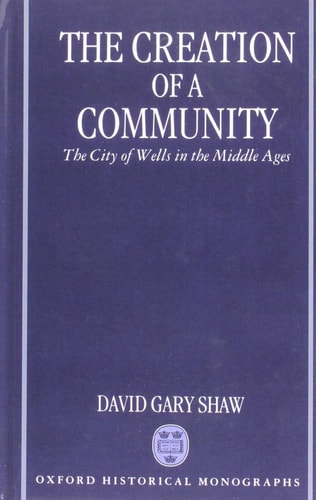
The Creation of a Community: The City of Wells in the Middle Ages
0
0
As an Amazon Associate and affiliate partner, Menrva Books earns from qualifying purchases. Learn more
Author Description
This is the first scholarly history of the city of Wells in the Middle Ages. David Gary Shaw traces the growth of Wells from a rural manor into the prosperous borough it became by the late twelfth century. Dr Shaw examines the variety of trades which flourished in Wells--including tanning, glove-making, and cloth-manufacture--and analyzes the composition of the burgess community. He also explores the importance of the family, the extent of social mobility, the position of women, and the roles of conviviality on the one hand and religion on the other in shaping communal activity and communal spirit.
Menrva's Summary
THE THESIS
This work investigates the socio-economic evolution of the city of Wells during the Middle Ages, questioning how a rural manor transformed into a thriving medieval borough. David Gary Shaw, a specialist in medieval social history, utilizes primary archival records and local administrative documents to reconstruct the city's development. He argues that the emergence of a distinct burgess community was driven by specific trade specializations, family structures, and the intersection of religious and civic life. The text provides a rigorous framework for understanding the mechanisms of social mobility and communal identity in a pre-modern urban setting.
THE SCOPE MAP
What You Will Find
- Analysis of medieval trade sectors including tanning, glove-making, and cloth-manufacture.
- Examination of the burgess community composition and social stratification.
- Investigation into the roles of women and family units within the urban hierarchy.
- Assessment of the influence of religious institutions and conviviality on communal spirit.
THE AUTHORITY PERSPECTIVE
Historians and scholars of medieval urbanism recognize this monograph as a foundational study for the specific history of Wells. Readers frequently note the academic density of the prose and the meticulous use of local primary source data to support broader historical arguments.
Page Count:
352
Publication Date:
1993-08-26
Publisher:
Clarendon Press
ISBN-10:
0198204019
ISBN-13:
9780198204015
History
Social History
Cities And Towns
Urban History
British History