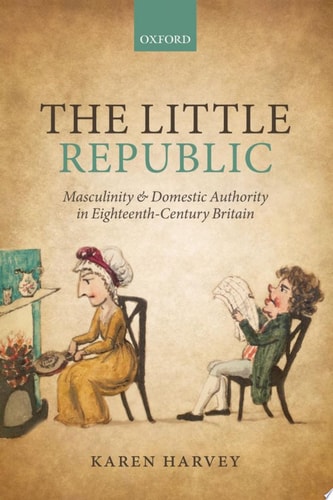
The Little Republic: Masculinity and Domestic Authority in Eighteenth-Century Britain
0
0
As an Amazon Associate and affiliate partner, Menrva Books earns from qualifying purchases. Learn more
Author Description
This is an open access title available under the terms of a CC BY-NC-ND 3.0 International licence. It is free to read at Oxford Scholarship Online and offered as a free PDF download from OUP and selected open access locations.The relationship between men and the domestic in eighteenth-century Britain has been obscured by two well-established historiographical narratives. The first charts changes in domestic patriarchy, founded on political patriarchalism in the early modern period and transformed during the eighteenth century by new types of family relationship rooted in contract theory. The second describes the emergence of a new kind of domestic interior during the long eighteenth century, a 'home' infused with a new culture of 'domesticity' primarily associated with women and femininity. Domesticating Patriarchy shifts the terms of these debates, rescuing the engagement of men with the house from obscurity, and better equipping historians to understand masculinity, the domestic environment, and domestic patriarchy.Karen Harvey explores how men represented and legitimized their domestic activities. She considers the relationship between discourses of masculinity and domesticity, and whether there was a particularly manly attitude to the domestic. In doing so, Harvey suggests that 'home' is too narrow a concept for an understanding of eighteenth-century domestic experience. Instead, focusing on the 'house' foregrounds a different domestic culture, one in which men and masculinity were central. Reconstructing men's experiences of the domestic as shaped by their own and others' beliefs, assumptions and expectations, Harvey argues for the continuation of a model of domestic patriarchy and also that effective domestic patriarchs remained important to late-eighteenth-century political theory. It was a discourse of 'oeconomy' - the practice of managing the economic and moral resources of the household for the maintenance of good order - that shaped men's attitudes towards and experiences in the house. Oeconomy combined day-to-day and global management of people and resources; it was a meaningful way of defining masculinity and established the house a key component of a manly identity that operated across the divide of 'inside' and 'outside' the house. Significantly for histories of the home which so often narrate a process of privatization and feminization, oeconomy brought together the home and the world, primarily through men's domestic management.
Menrva's Summary
THE THESIS
This book investigates the role of men in the domestic sphere of eighteenth-century Britain, challenging the historiographical assumption that the home was an exclusively feminine domain. Karen Harvey, a historian specializing in gender and social history, utilizes primary source materials and contemporary political theory to re-examine the concept of domestic patriarchy. She argues that the practice of 'oeconomy'—the management of household resources—served as a crucial framework through which men legitimized their authority and maintained social order within the house.
THE SCOPE MAP
What You Will Find
- An analysis of eighteenth-century domestic patriarchy and its evolution through contract theory.
- A critical examination of the shift from the concept of 'home' to the more expansive 'house' as a site of masculine engagement.
- Primary source evidence including personal accounts, household management records, and political treatises.
- A historical framework linking domestic management to broader political theory and masculine identity.
THE AUTHORITY PERSPECTIVE
Historians and scholars of gender studies recognize this work as a significant intervention in the study of eighteenth-century domestic life. Experts frequently note the academic rigor of Harvey's research and her success in complicating the traditional narrative of the feminized domestic sphere.
Page Count:
256
Publication Date:
2012-06-18
Publisher:
Oxford University Press
ISBN-10:
0199533849
ISBN-13:
9780199533848
History
Great Britain
Conduct Of Life
Cultural History
Gender Studies
Social History
Households
British History
Community Tags
Similar Books





Reader Comments
Share Your Thoughts
No comments yet. Be the first to share your thoughts!