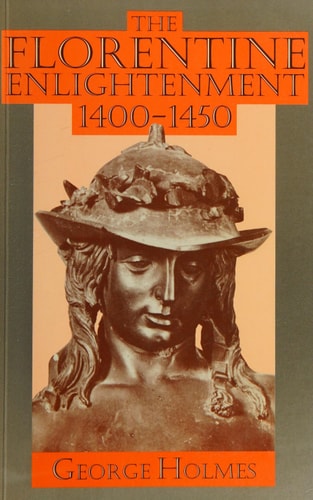
The Florentine Enlightenment
0
0
As an Amazon Associate and affiliate partner, Menrva Books earns from qualifying purchases. Learn more
Author Description
A study of the revolutionary development in art and thought which took place in early fifteenth-century Florence, this book is a new approach to political philosophy, history, art, and architecture that was inspired by the teaching and writings of a group of humanist thinkers who paved the way for the great achievements of the later Renaissance. Holmes explores the ideas of the humanists and traces their influence on the writing of history, political philosophy, and aesthetics. The new humanist secular thought was paralleled, and even directly applied in some cases, by a number of brilliant Florentine artists headed by Brunelleschi, Donatello, and Masaccio. In architecture, sculpture, and painting these men produced masterpieces which gave form to the humanist ideal of classical inspiration related to real life. Holmes examines this brief but enlightened phase in the history of art and ideas within its historical context, setting it against the background of Florence's fluctuating relationship with an enfeebled papacy and the wider Italian political scene.
Menrva's Summary
THE THESIS
This book investigates the intellectual and artistic transformation of early fifteenth-century Florence, questioning how humanist thought catalyzed a shift in political philosophy and aesthetic expression. George Holmes, a respected historian of the Italian Renaissance, utilizes primary source writings and historical records to construct a framework that links secular humanist philosophy with the physical innovations of the era. He argues that the convergence of political instability and intellectual inquiry created a unique environment where classical ideals were reinterpreted for contemporary life. By examining the interplay between thinkers and practitioners, Holmes demonstrates how the intellectual climate directly informed the structural and visual language of the period.
THE SCOPE MAP
What You Will Find
- Analysis of the intellectual contributions of early fifteenth-century Florentine humanist thinkers.
- Examination of the intersection between political philosophy and the development of secular thought.
- Case studies of artistic and architectural innovations by figures such as Brunelleschi, Donatello, and Masaccio.
- Contextualization of Florentine cultural output against the backdrop of Italian political dynamics and the papacy.
THE AUTHORITY PERSPECTIVE
Scholars and historians frequently cite this work as a foundational text for understanding the transition into the high Renaissance. Readers often note the academic density of the prose, which provides a rigorous examination of the period's complex socio-political landscape.
Page Count:
320
Publication Date:
1992-07-16
Publisher:
Oxford University Press
ISBN-10:
019820292X
ISBN-13:
9780198202929
Architecture
Philosophy
History
Humanism
Renaissance
Art History
Florence Italy
Community Tags
Similar Books