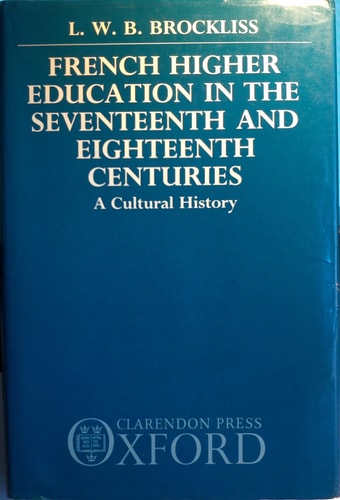
French Higher Education in the Seventeenth and Eighteenth Centuries: A Cultural History
0
0
As an Amazon Associate and affiliate partner, Menrva Books earns from qualifying purchases. Learn more
Author Description
At a time when the role of universities is being constantly questioned, this book looks back to their function during a period when the state--in this case, France--first demanded that institutions of higher learning be socially relevant. Using evidence from surviving student cahiers and professorial textbooks, Brockliss recreated the educational experience of the French professional classes in the age of absolutism. The picture that emerges is one of a higher education system playing a dual role within the culture: on the one hand, developing and promoting a justification of the divine-right monarchy; on the other, acting as a vital agent in transmitting and popularizing the new scientific and philosophical ideas that eventually contributed to the overthrow of the state.
Menrva's Summary
THE THESIS
This work investigates how the French higher education system functioned as both a pillar of divine-right monarchy and a catalyst for the intellectual shifts that preceded the French Revolution. L. W. Brockliss, a historian specializing in early modern French education, utilizes a vast array of primary sources to reconstruct the pedagogical environment of the seventeenth and eighteenth centuries. By analyzing student cahiers and contemporary textbooks, the author argues that universities were not static institutions but active participants in the socio-political evolution of the French professional classes.
THE SCOPE MAP
What You Will Find
- Analysis of the curriculum and pedagogical methods used in French universities during the age of absolutism.
- Examination of student cahiers and professorial textbooks as primary evidence of intellectual transmission.
- Exploration of the dual role of higher education in supporting the monarchy while disseminating subversive scientific and philosophical ideas.
- Historical context regarding the state's early demands for social relevance in higher learning institutions.
THE AUTHORITY PERSPECTIVE
Scholars recognize this text as a foundational study of early modern French intellectual life and institutional history. Readers frequently note the academic density of the prose, which provides a comprehensive and detailed account of the period's educational landscape.
Page Count:
544
Publication Date:
1987-05-21
Publisher:
Oxford University Press
ISBN-10:
0198219881
ISBN-13:
9780198219880
History
Education
Cultural History
France
Community Tags
Similar Books