Do You Make These Mistakes in English?: The Story of Sherwin Cody's Famous Language School
0
0
As an Amazon Associate and affiliate partner, Menrva Books earns from qualifying purchases. Learn more
Author Description
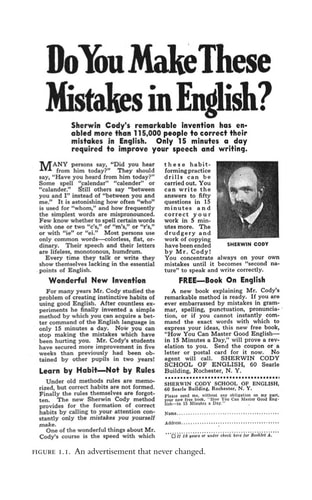
In the early 1900s, the language of America was becoming colloquial English-the language of the businessman, manager, and professional. Since college and high school education were far from universal, many people turned to correspondence education-that era's distance learning-to learn the art of speaking and writing. By the 1920s and 1930s, thousands of Americans were sending coupons from newspapers and magazines to order Sherwin Cody's 100% Self-correcting Course in the English Language, a patented mail-order course in English that was taken by over 150,000 people.Cody's ubiquitous signature advertisement, which ran for over forty years, promised a scientifically-tested invention that improved speaking and writing in just 15 minutes a day. Cody's ad explained that people are judged by their English, and he offered self-improvement and self-confidence through the mail.In this book, linguist Edwin Battistella tells the story of Sherwin Cody and his famous English course, situating both the man and the course in early twentieth century cultural history. The author shows how Cody became a businessman-a writer, grammatical entrepreneur, and mass-marketer whose ads proclaimed "Good Money in Good English" and asked "Is Good English Worth 25 Cents to You?" His course, perhaps the most widely-advertised English education program in history, provides a unique window onto popular views of language and culture and their connection to American notions of success and failure. But Battistella shows Sherwin Cody was also part of a larger shift in attitudes. Using Cody's course as a reference point, he also looks at the self-improvement ethic reflected in such courses and products as the Harvard Classics, The Book of Etiquette, the Book-of-the-Month Club, the U.S. School of Music, and the Charles Atlas and Dale Carnegie courses to illustrate how culture became popular and how self-reliance evolved into self-improvement.
Menrva's Summary
THE THESIS
How did Sherwin Cody’s correspondence course transform the American perception of language into a commodity for social and professional advancement? Linguist Edwin L. Battistella examines the rise of Sherwin Cody’s mail-order English program within the context of early twentieth-century American culture. By analyzing the intersection of mass marketing, the self-improvement movement, and changing educational standards, the author argues that Cody’s course served as a barometer for how Americans defined success through linguistic competence. The book utilizes historical advertisements, correspondence records, and cultural artifacts to map the evolution of distance learning and the professionalization of the American workforce.
THE SCOPE MAP
What You Will Find
- Historical analysis of the early twentieth-century correspondence education market.
- Examination of mass-marketing techniques used by grammatical entrepreneurs.
- Comparative study of self-improvement products like the Harvard Classics and Dale Carnegie courses.
- Insights into the cultural connection between standardized English and social mobility.
THE AUTHORITY PERSPECTIVE
Experts recognize this work as a significant contribution to the history of American popular culture and the sociology of language. Readers frequently note the accessible yet scholarly approach Battistella takes in documenting the influence of mail-order education on the American psyche.
Page Count:
224
Publication Date:
2008-12-01
Publisher:
Oxford University Press
ISBN-10:
019536712X
ISBN-13:
9780195367126
History
Biography
Correspondence Schools And Courses
American History
Language And Culture
Cultural History
Linguistics
Education
Businesspeople biography
United States
Community Tags
Other Editions(2)
Similar Books








Reader Comments
Share Your Thoughts
No comments yet. Be the first to share your thoughts!