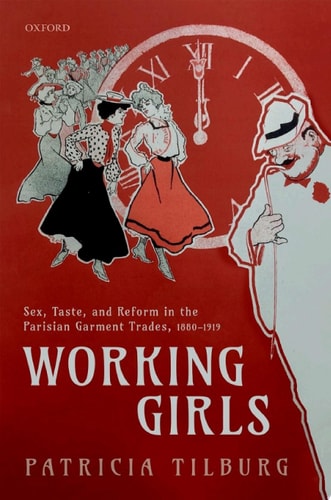
Working Girls: Sex, Taste, and Reform in the Parisian Garment Trades, 1880-1919
0
0
As an Amazon Associate and affiliate partner, Menrva Books earns from qualifying purchases. Learn more
Author Description
As the twentieth century dawned and France entered an era of extraordinary labor activism and industrial competition, an insistently romantic vision of the Parisian garment worker was deployed by politicians, reformers, and artists to manage anxieties about economic and social change. Nostalgia about a certain kind of France was written onto the bodies of the capital's couture workers throughout French pop culture from the 1880s to the 1930s. And the midinettes-as these women were called- were written onto the geography of Paris itself, by way of festivals, monuments, historic preservation, and guide books. The idealized working Parisienne stood in for, at once, the superiority of French taste and craft, and the political (and sexual) subordination of French women and labour. But she was also the public face of more than 80,000 real working women whose demands for better labour conditions were inflected, distorted, and, in some cases, amplified by this ubiquitous Romantic type in the decades straddling World War I. Working Girls bridges cultural histories of the Parisian imaginary and histories of French labour, and puts them in raucous dialogue with one another: a letter by a nineteen-year-old seamstress, a speech by a government minister; a frothy Parisian guide by a bon vivant, the minutes of a union meeting; a bawdy café-concert song, a policy brief on garment working conditions.
Menrva's Summary
THE THESIS
This work investigates how the idealized image of the Parisian garment worker, or midinette, was constructed and utilized by French society to reconcile anxieties regarding industrialization, labor activism, and national identity between 1880 and 1919. Patricia A. Tilburg, a historian of modern France, examines the intersection of cultural representation and economic reality. She argues that the romanticized figure of the seamstress served as a symbolic proxy for French taste and craft while simultaneously obscuring the political and material demands of actual working women.
THE SCOPE MAP
What You Will Find
- Analysis of the midinette archetype in French pop culture, festivals, and literature.
- Examination of labor union records and government policy briefs regarding garment workers.
- Comparative study of primary sources ranging from personal letters to café-concert songs.
Scope Limits
- The study focuses primarily on the Parisian garment trades and does not provide an exhaustive history of French industrial labor outside the capital.
- The analysis concludes in 1919, leaving the subsequent evolution of these specific labor archetypes in the later twentieth century largely unaddressed.
THE AUTHORITY PERSPECTIVE
Scholars frequently cite this text for its innovative methodology in bridging cultural history with the study of labor movements. Experts highlight the author's ability to synthesize diverse primary sources to reveal the tension between public perception and the lived experience of the working class.
Page Count:
284
Publication Date:
2019-01-01
Publisher:
OUP Oxford
ISBN-10:
0192578073
ISBN-13:
9780192578075
History
Gender Studies
France
Cultural History
European History
Sociology
Costume_france
Clothing trade
Women
Clothing workers
Labor history
Community Tags
Similar Books