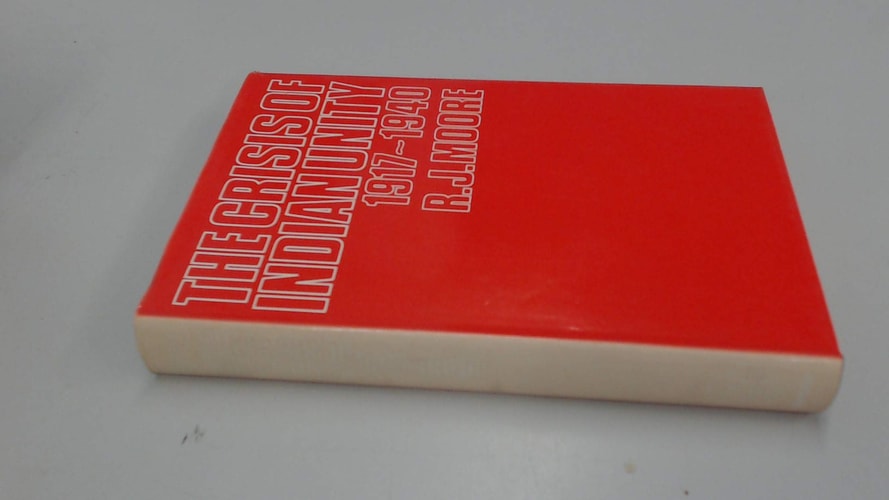
The crisis of Indian unity, 1917-1940
0
0
As an Amazon Associate and affiliate partner, Menrva Books earns from qualifying purchases. Learn more
Author Description
This is the first analysis of "The Indian Problem" between the two world wars. The problem was to find a form of government that satisfied Indian aspirations as well as British interests, and that would preserve in freedom the unity Empire had imposed. The seminal years were the early thirties, when the British parties, together with the Indian Princes, Muslims, Liberals, and Minority Groups, worked towards an all-India Federation at a Round Table Conference in London, while in India the National Congress adopted civil disobedience in order to establish a national mandate for early independence. This study of the failure of the British and Indian experiments with unity provides the necessary historical perspective for understanding the sub-continent's attainment of freedom by partition in 1947....
Menrva's Summary
THE THESIS
This work investigates the failure of British and Indian political experiments to establish a unified, independent state between 1917 and 1940. Robin James Moore, a scholar of imperial history, utilizes archival records and parliamentary proceedings to analyze the competing interests of the British government, the Indian National Congress, and various minority factions. The author argues that the inability to reconcile imperial mandates with nationalist aspirations ultimately necessitated the partition of the subcontinent.
THE SCOPE MAP
What You Will Find
- Analysis of the Round Table Conferences held in London during the early 1930s.
- Examination of the political tension between the Indian National Congress and the British administration.
- Evaluation of the role of Indian Princes, Muslims, and minority groups in the federalist debate.
- Historical context regarding the transition from colonial rule to the partition of 1947.
THE AUTHORITY PERSPECTIVE
Historians recognize this text as a foundational analysis of the constitutional crises that defined the final decades of the British Raj. Scholars frequently cite the book for its detailed documentation of the failed federalist experiments that preceded the eventual independence and partition of India.
Page Count:
346
Publication Date:
1974-01-01
Publisher:
Oxford University Press
ISBN-10:
0198215606
ISBN-13:
9780198215608
History
Colonialism
British Empire
India
20th Century