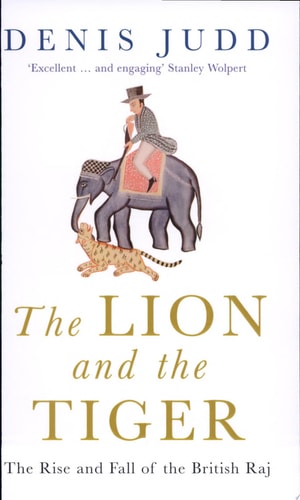
The Lion and the Tiger: The Rise and Fall of the British Raj, 1600-1947
0
0
As an Amazon Associate and affiliate partner, Menrva Books earns from qualifying purchases. Learn more
Author Description
The British experience in India began in earnest over four hundred years ago, during the reign of Queen Elizabeth I. For many years the English interlopers and traders who made contact with the subcontinent were viewed by Indians as little more than pirates and potentially troublesome conquering barbarians. After a series of titanic struggles against the French and various local rulers during the eighteenth century, by the end of the Napoleonic Wars Britain had gained mastery of the subcontinent. This period, and the century and a half that followed, saw two powerful cultures locked in an often bloody battle over political control, land, trade, and a way of life.Denis Judd tells the fascinating story of the remarkable British impact upon India. All aspects of this long and controversial relationship are discussed, such as the first tentative contacts between East and West, the foundation of the East India Company in 1600, the Victorian Raj in all its pomp and splendour, Gandhi's revolutionary tactics tooverthrow the Raj and restore Indian to the Indians, and Lord Mountbatten's 'swift surgery of Partition' in 1947, creating the two independent Commonwealth states of India and Pakistan. Against this epic backdrop, and using many revealing contemporary accounts, Denis Judd explores the consequences of British rule for both rulers and ruled. Were the British intent on development or exploitation? Were they the "civilizing" force they claimed? What were Britain's greatest legacies: democracy and the rule of law, or cricket and an efficient railway system? Easy answers are avoided in this immensely readable, lively, and authoritative book.
Menrva's Summary
THE THESIS
This work investigates the complex historical trajectory of the British Raj, questioning the motivations behind British colonial rule and the long-term impact of their presence on the Indian subcontinent. Denis Judd, a historian specializing in the British Empire, utilizes a synthesis of primary source accounts and historical analysis to examine the relationship between the British administration and the Indian population. The text evaluates the transition from the East India Company's commercial interests to the formal Victorian Raj, ultimately analyzing the socio-political consequences of the 1947 Partition.
THE SCOPE MAP
What You Will Find
- Chronological overview of British presence in India from 1600 to 1947
- Analysis of the East India Company's influence and the subsequent Victorian administration
- Examination of the independence movement led by figures such as Gandhi
- Discussion of the logistical and political implications of the 1947 Partition
Scope Limits
- Does not provide an exhaustive biography of every colonial administrator
- Does not focus on pre-1600 Indian history beyond brief context
THE AUTHORITY PERSPECTIVE
Critics and historians often cite this work as a balanced, accessible entry point for those seeking to understand the mechanics of the British Raj. Readers frequently note that the prose maintains an objective tone while effectively navigating the controversial legacy of colonial rule.
Page Count:
234
Publication Date:
2010-03-19
Publisher:
Oxford University Press
ISBN-10:
0192805797
ISBN-13:
9780192805799
History
British Empire
India
Colonialism
Asian History
Political History
Community Tags
Similar Books