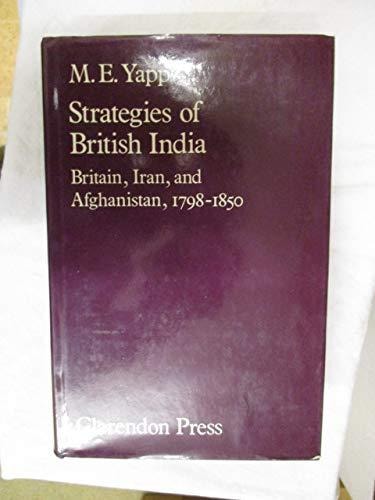
Strategies of British India: Britain, Iran, and Afghanistan, 1798-1850
0
0
As an Amazon Associate and affiliate partner, Menrva Books earns from qualifying purchases. Learn more
Author Description
In 1798 the possibility of attacks upon British India by Afghanistan and France led to the first consideration of a suitable system of distant defence for that continent. Until 1838 Britain's favoured strategy made Iran the main buffer state, but disappointment with the Iranian alliance led Britain to investigate the possibilities of a system based on Afghanistan which led to the first Anglo-Afghan war in 1839. the collapse of the Afghan strategy in 1842 led to concentration on strengthening the British-Indian frontier itself, through the annexation of Sind and in 1849, of the Punjab.Using a large selection of official and private papers, Dr. Yapp surveys the perception of dangers to British India, the discussion of appropriate defensive strategies, the implementation of programmes of action, and the recasting of plans in the light of experience at all levels, from the Cabinet to the frontier agent. His main theme is the nature of strategy itself; is it a disposition of resources to deal with a real problem, or a device for the satisfaction of diverse interests? he challenges accepted theories of the importance of the defence of British Indian in the formulation of British foreign policy, and asserts that the priorities of Britain and British India were very different, and that strategy of defence against the distant enemy of British India was mainly a convenient mode of achieving the semblance, but not the reality of unity in British foreign policy.
Menrva's Summary
THE THESIS
This work investigates the evolution of British defensive strategies for India between 1798 and 1850, questioning whether these policies were genuine responses to external threats or mechanisms for managing internal political interests. Dr. Malcolm Yapp, a respected historian of the Middle East and South Asia, utilizes an extensive array of official government documents and private correspondence to reconstruct the decision-making processes of the era. He argues that the perceived threat to British India served primarily as a rhetorical tool to project a unified foreign policy, despite the often conflicting priorities between London and the colonial administration in India.
THE SCOPE MAP
What You Will Find
- Analysis of the geopolitical shift from an Iranian-centered buffer strategy to an Afghan-focused defense model.
- Examination of the administrative and military consequences of the first Anglo-Afghan War and the subsequent annexations of Sind and the Punjab.
- Primary source research derived from Cabinet records, diplomatic correspondence, and the reports of frontier agents.
- A critical framework evaluating the nature of strategic planning and the divergence of interests within the British imperial hierarchy.
THE AUTHORITY PERSPECTIVE
Historians and scholars of the British Empire frequently cite this text as a foundational analysis of the 'Great Game' era and the complexities of colonial defense policy. Readers often note the academic density of the prose, which provides a rigorous, detailed account of the bureaucratic and strategic maneuvers that defined British involvement in Central Asia.
Page Count:
690
Publication Date:
1980-08-21
Publisher:
Oxford University Press
ISBN-10:
0198224818
ISBN-13:
9780198224815
History
British Empire
Military History
International relations
Community Tags
Similar Books