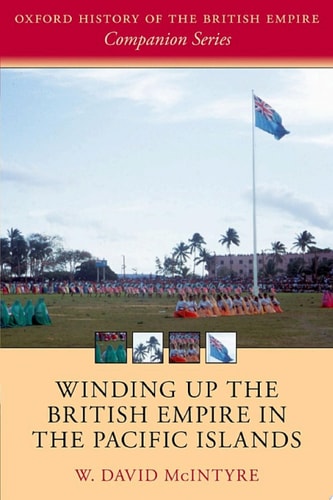
Winding Up the British Empire in the Pacific Islands
0
0
As an Amazon Associate and affiliate partner, Menrva Books earns from qualifying purchases. Learn more
Author Description
Little has been written about when, how and why the British Government changed its mind about giving independance to the Pacific Islands. Using recently opened archives, Winding Up the British Empire in the Pacific Islands gives the first detailed account of this event. As Britain began to dissolve the Empire in Asia in the aftermath of the Second World War, it announced that there were some countries that were so small, remote, and lacking in resources that they could never become independent states. However, between 1970 and 1980 there was a rapid about-turn. Accelerated decolonization suddenly became the order of the day. Here was the death warrant of the Empire, and hastily-arranged independence ceremonies were performed for six new states - Tonga, Fiji, Solomon Islands, Tuvalu, Kiribati, and Vanuatu. The rise of anti-imperialist pressures in the United Nations had a major role in this change in policy, as did the pioneering examples marked by the release of Western Samoa by New Zealand in 1962 and Nauru by Australia in 1968. The tenacity of Pacific Islanders in maintaining their cultures was in contrast to more strident Afro-Asia nationalisms. The closing of the Colonial Office, by merger with the Commonwealth Relations Office in 1966, followed by the joining of the Commonwealth and Foreign Offices in 1968, became a major turning point in Britain's relations with the Islands. In place of long-nurtured traditions of trusteeship for indigenous populations that had evolved in the Colonial Office, the new Foreign & Commonwealth Office concentrated on fostering British interests, which came to mean reducing distant commitments and focussing on the Atlantic world and Europe.
Menrva's Summary
THE THESIS
This work investigates the factors that prompted the British government to reverse its policy regarding the independence of Pacific Island territories between 1970 and 1980. W. David McIntyre, a historian specializing in Commonwealth studies, utilizes recently declassified archival materials to reconstruct the administrative and geopolitical shifts that led to the rapid dissolution of British colonial presence in the region. The text argues that the transition was driven by a combination of United Nations pressure, regional precedents set by New Zealand and Australia, and a fundamental restructuring of the British Foreign and Commonwealth Office.
THE SCOPE MAP
What You Will Find
- Analysis of the administrative merger between the Colonial Office and the Commonwealth Relations Office.
- Comparative study of decolonization timelines for Tonga, Fiji, Solomon Islands, Tuvalu, Kiribati, and Vanuatu.
- Examination of the influence of anti-imperialist sentiment within the United Nations.
Scope Limits
- The text does not provide an exhaustive cultural history of the Pacific Islands themselves.
- The analysis focuses primarily on British administrative policy rather than the internal domestic politics of the newly independent states.
THE AUTHORITY PERSPECTIVE
Scholars recognize this text as a primary resource for understanding the administrative mechanics of the late British Empire. Readers frequently note the academic density of the prose, which relies heavily on primary source documentation to support its historical arguments.
Page Count:
272
Publication Date:
2016-01-01
Publisher:
OUP Oxford
ISBN-10:
0192513613
ISBN-13:
9780192513618
History
British Empire
European History
Great Britain
Special Topics
International relations
Decolonization
Pacific Islands
Pacific Area
Community Tags
Other Editions(3)

Similar Books


Reader Comments
Share Your Thoughts
No comments yet. Be the first to share your thoughts!