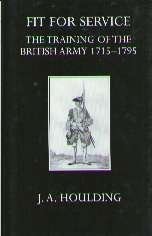
Fit for Service: The Training of the British Army, 1715-1795
0
0
As an Amazon Associate and affiliate partner, Menrva Books earns from qualifying purchases. Learn more
Author Description
In Fit For Service Professor Houlding successfully demonstrates traditional arguments that purchasing officer commissions and lack of drill regulations were not the cause of poor results in the first campaign each year of war from 1715 to 1795. His exhaustive research of marching orders, drill books, civil reports show that the army was largely hamstrung by its duties as what amounted to military police. The army was used to quell food riots, support revenue agents against smugglers, even protect the gentry's estates. The army was distributed in small units across the country for a number of reasons starting with the long-standing fear of a standing army. Houlding shows that battalion commanders (Lieutenant Colonels) rarely had the opportunity to bring together even half of their men to practice. Consequently, it took a "campaign season" to prepare both men and commanders to work in larger bodies.
Menrva's Summary
THE THESIS
This work investigates the systemic factors that hindered the operational readiness of the British Army during the eighteenth century. Professor J. A. Houlding challenges the conventional historiography that attributes early-campaign failures to the purchase of commissions or a lack of formal drill regulations. By analyzing primary source documentation, including marching orders and civil reports, the author argues that the army's primary role as a domestic police force prevented the cohesive training necessary for large-scale warfare. The study posits that the geographic dispersion of troops, necessitated by political anxieties regarding a standing army, created a structural inability to conduct battalion-level exercises until the onset of active conflict.
THE SCOPE MAP
What You Will Find
- A detailed examination of British military operations and training protocols from 1715 to 1795.
- Analysis of the socio-political constraints that forced the army to act as domestic law enforcement.
- Evidence derived from archival drill books, administrative marching orders, and contemporary civil reports.
- An evaluation of the logistical impact of small-unit distribution on battalion commander effectiveness.
THE AUTHORITY PERSPECTIVE
Historians and military scholars recognize this text as a definitive analysis of the administrative and operational realities of the Georgian-era British Army. Readers frequently note the academic density of the prose and the author's meticulous use of primary source evidence to dismantle long-standing myths regarding military incompetence.
Page Count:
482
Publication Date:
1981-09-03
Publisher:
Oxford University Press
ISBN-10:
0198226470
ISBN-13:
9780198226475
History
18th century
Great Britain
Military Science
British History
Military History
Community Tags
Similar Books