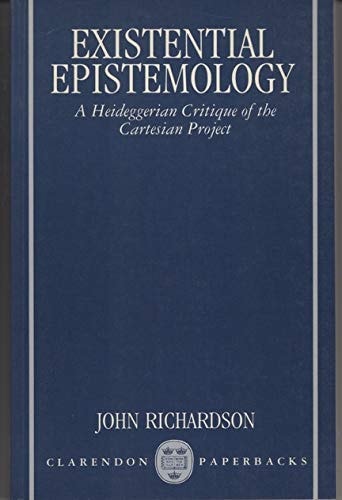
Existential Epistemology: A Heideggerian Critique of the Cartesian Project
0
0
As an Amazon Associate and affiliate partner, Menrva Books earns from qualifying purchases. Learn more
Author Description
A lucid introduction to the "existential phenomenology" of Martin Heidegger, particularly as developed in his major work, Being and Time, this work focuses on how Heidegger's ideas bear on the central problem in epistemology--that of how we can have objective knowledge. The author constructs fresh arguments clarifying Heidegger's contribution to the theory of knowledge, and shows why Heidegger deemed misguided the search for knowledge of the way things are in themselves.
Menrva's Summary
THE THESIS
This work investigates the fundamental question of whether objective knowledge is possible within the framework of Heideggerian existential phenomenology, specifically challenging the traditional Cartesian epistemological project. John Richardson, a scholar of continental philosophy, utilizes the core tenets of Martin Heidegger’s Being and Time to dismantle the subject-object dichotomy. The author argues that the search for knowledge of things in themselves is fundamentally misguided, proposing instead a shift toward understanding how human existence structures the possibility of knowing.
THE SCOPE MAP
What You Will Find
- A critical analysis of the Cartesian epistemological tradition and its limitations.
- A detailed examination of Heidegger’s existential phenomenology as presented in Being and Time.
- Philosophical arguments regarding the nature of objectivity and human perception.
- A re-evaluation of the relationship between the knower and the known world.
THE AUTHORITY PERSPECTIVE
Scholars and students of continental philosophy frequently cite this text for its clarity in navigating the dense terminology of Heideggerian thought. It is widely regarded as a foundational resource for those attempting to reconcile existentialism with classical epistemological concerns.
Page Count:
224
Publication Date:
1991-05-09
Publisher:
Oxford University Press
ISBN-10:
019823922X
ISBN-13:
9780198239222
Non-Fiction
Philosophy
Knowledge Theory
Epistemology
Existentialism
Phenomenology
Community Tags
Similar Books