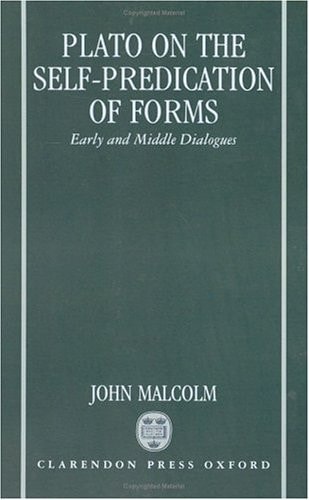
Plato on the Self-Predication of Forms: Early and Middle Dialogues
0
0
As an Amazon Associate and affiliate partner, Menrva Books earns from qualifying purchases. Learn more
Author Description
In this book, Malcolm presents a new and radical interpretation of Plato's earlier dialogues. He argues that the few cases of self-predication contained therein are acceptable simply as statements concerning universals, and that therefore Plato is not vulnerable in these cases to the Third Man Argument. In considering the middle dialogues, Malcolm takes a conservative stance, rejecting influential current doctrines which portray the Forms as being not self-predicative. He shows that the middle dialogues do indeed take Forms to be both universals and paradigms, and thus to exemplify themselves. The author goes on to consider why Plato should have been unsuccessful in avoiding self-predication. He shows that Plato's concern to explain how the truths of mathematics can indeed be true played an important role in his postulation of the Form as an Ideal Individual. The author concludes with the claim that reflection on the ambiguity of the notion of the "Standard Yard" may help us to appreciate why Plato failed to distinguish Forms as universals from Forms as paradigm cases.
Menrva's Summary
THE THESIS
This book investigates the logical consistency of Plato's theory of Forms, specifically addressing the role and validity of self-predication across his early and middle dialogues. John Malcolm, a scholar of ancient philosophy, utilizes a rigorous analytical framework to re-examine the Third Man Argument and the ontological status of Forms. He argues that Plato's early dialogues treat self-predication as a function of universals, while the middle dialogues maintain a dual role for Forms as both universals and paradigms, ultimately explaining Plato's struggle to distinguish these two concepts through his focus on mathematical truth and the Ideal Individual.
THE SCOPE MAP
What You Will Find
- Analysis of self-predication within Plato's early and middle dialogue periods.
- Examination of the Third Man Argument and its impact on Platonic theory.
- Comparative study of Forms as universals versus Forms as paradigm cases.
- Investigation into the influence of mathematical truth on Plato's metaphysical postulations.
THE AUTHORITY PERSPECTIVE
Scholars and students of ancient philosophy frequently cite this work for its precise, technical approach to Platonic metaphysics. Experts highlight the text as a significant contribution to the ongoing debate regarding the consistency of Plato's logical development.
Page Count:
231
Publication Date:
1991-08-15
Publisher:
Clarendon Press
ISBN-10:
0198239068
ISBN-13:
9780198239062
Philosophy
Epistemology
Plato
Metaphysics
Platonism
Community Tags
Similar Books