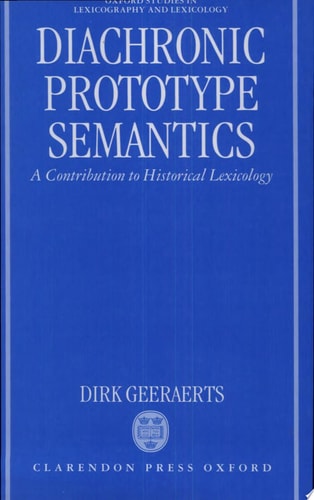
Diachronic Prototype Semantics: A Contribution to Historical Lexicology
0
0
As an Amazon Associate and affiliate partner, Menrva Books earns from qualifying purchases. Learn more
Author Description
Prototype theory makes a crucial distinction between central and peripheral sense of words. Geeraerts explores the implications of this model for a theory of semantic change, in the first full-scale treatment of the impact of the most recent developments in lexicological theory on the study of meaning change. He identifies structural features of the development of word meanings which follow from a prototype-theoretical model of semantic structure, and incorporates these diachronic prototypicality effects into a theory of meaning change.
Menrva's Summary
THE THESIS
This work investigates how prototype theory can be systematically applied to the study of semantic change over time. Dirk Geeraerts, a prominent scholar in cognitive linguistics, utilizes historical lexicological data to bridge the gap between synchronic prototype models and diachronic language evolution. He argues that word meanings do not shift randomly but follow structural patterns dictated by the relationship between central and peripheral senses, providing a formal framework for understanding how lexical items evolve within a language system.
THE SCOPE MAP
What You Will Find
- A comprehensive application of prototype theory to historical semantic change.
- Analysis of structural development patterns in word meanings.
- Integration of diachronic prototypicality effects into lexicological theory.
- Methodological approaches to mapping shifts in lexical sense over time.
THE AUTHORITY PERSPECTIVE
Experts recognize this volume as a foundational text for scholars interested in the intersection of cognitive linguistics and historical lexicology. Readers frequently note the academic density of the prose, which requires a strong background in linguistic theory to fully appreciate the author's rigorous analytical framework.
Page Count:
224
Publication Date:
1997-05-29
Publisher:
Clarendon Press
ISBN-10:
0198236522
ISBN-13:
9780198236528
Historical linguistics
Linguistics
Lexicology
Semantics
Academic