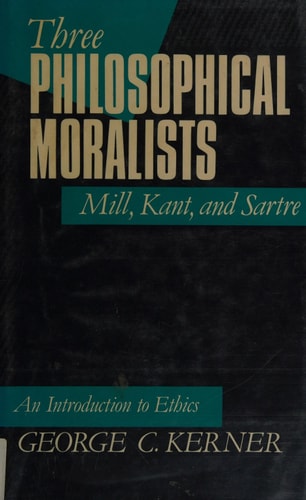
Three Philosophical Moralists: Mill, Kant, and Sartre: An Introduction to Ethics
0
0
As an Amazon Associate and affiliate partner, Menrva Books earns from qualifying purchases. Learn more
Author Description
This book is a unique and up-to-date introduction to moral philosophy. Kerner defines ethics as the study of what makes life worth living and gives it meaning. Rather than cataloging how various ethical theories bear on ethical issues, he poses the central question: is objective moral knowlege possible? To address that question, he provides an exacting analysis of the works of Mill, Kant, and Sartre, and finally agrees with Sartre that such knowlege is not possible; in morality there are no objective answers but only questions direted at our deep subjectivity.
Menrva's Summary
THE THESIS
This book investigates the central question of whether objective moral knowledge is possible through a critical examination of three major philosophical figures. George C. Kerner, an academic philosopher, utilizes the foundational texts of John Stuart Mill, Immanuel Kant, and Jean-Paul Sartre to construct his argument. By analyzing their disparate approaches to moral reasoning, Kerner evaluates the validity of objective ethics and ultimately concludes that moral knowledge is inherently subjective rather than objective.
THE SCOPE MAP
What You Will Find
- Comparative analysis of utilitarian, deontological, and existentialist ethical frameworks
- Examination of the works of John Stuart Mill, Immanuel Kant, and Jean-Paul Sartre
- Philosophical inquiry into the nature of moral objectivity versus deep subjectivity
- A structured introduction to the foundational problems of moral philosophy
THE AUTHORITY PERSPECTIVE
Experts and students of philosophy often cite this work as a clear, accessible entry point for understanding the divergence between classical and existentialist moral thought. Readers frequently note the clarity of Kerner's prose, which effectively distills complex arguments into a coherent critique of objective morality.
Page Count:
224
Publication Date:
1990-05-17
Publisher:
Oxford University Press
ISBN-10:
0198242271
ISBN-13:
9780198242277
Philosophy
Non-Fiction
Ethics
Community Tags
Similar Books