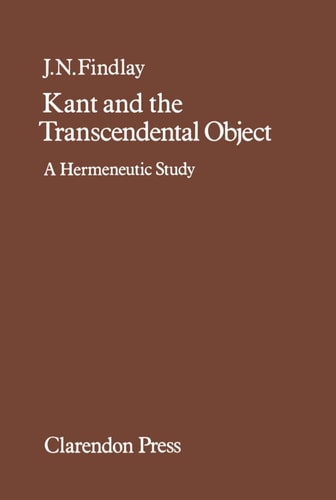
Kant and the Transcendental Object: A Hermeneutic Study
0
0
As an Amazon Associate and affiliate partner, Menrva Books earns from qualifying purchases. Learn more
Author Description
Attempts to analyze and interpret Kant's metaphysic of transcendental idealism, with its distinction between those aspects of objects which have a meaning of knowledge, and involve empirical criteria, and those other aspects of knowledge which can only be referred to in an 'empty,' formal manner, without empirical content.
Menrva's Summary
THE THESIS
This work investigates the core tension within Immanuel Kant’s transcendental idealism regarding the nature of the transcendental object and its relationship to empirical knowledge. J. N. Findlay, a prominent philosopher known for his work on phenomenology and value theory, provides a rigorous hermeneutic analysis of the Critique of Pure Reason. He examines how Kant distinguishes between objects defined by empirical criteria and those formal aspects of knowledge that remain empty of empirical content. The text serves as a systematic attempt to reconcile the formalist and realist interpretations of Kantian metaphysics.
THE SCOPE MAP
What You Will Find
- A detailed examination of the transcendental object as a formal limit of knowledge.
- Analysis of the distinction between empirical criteria and formal referents.
- A hermeneutic methodology applied to the primary texts of Immanuel Kant.
- Discussion on the limits of human cognition and the structure of experience.
THE AUTHORITY PERSPECTIVE
Scholars frequently note the high level of technical density in Findlay’s prose, which requires a strong background in Kantian terminology. It is widely regarded as a specialized study that contributes significantly to the ongoing debate regarding the interpretation of Kant’s transcendental idealism.
Page Count:
392
Publication Date:
1981-05-07
Publisher:
Oxford University Press
ISBN-10:
0198246382
ISBN-13:
9780198246381
Philosophy
Academic
Metaphysics
Epistemology
Kant
Community Tags
Similar Books