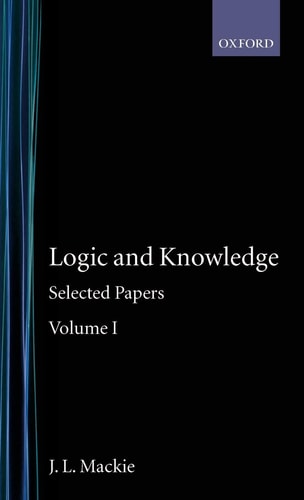
Logic and Knowledge: Selected Papers Volume I
0
0
As an Amazon Associate and affiliate partner, Menrva Books earns from qualifying purchases. Learn more
Author Description
This collection of John Mackie's papers on topics in epistemology, some of which have not previously been published, deal with such issues as: incorrigible empirical statements; rationalism and empiricism; the philosophy of John Anderson; self-refutation; Plato's theory of idea; ideological explanation; problems of intentionality; Popper's third world;; mind, brain, and causation; Newcomb's Paradox and the direction of causation; induction; causation in concept, knowledge, and reality; absolutism; Locke and representative perception; and anti-realisms.
Menrva's Summary
THE THESIS
This collection investigates the foundational problems of epistemology, logic, and metaphysics through the rigorous analytical lens of J. L. Mackie. Mackie, a prominent philosopher known for his work in ethics and metaphysics, compiles a series of papers that examine the limits of human knowledge, the nature of causation, and the validity of various philosophical frameworks. By addressing both historical figures like Plato and Locke and contemporary thinkers like Popper, the text provides a systematic evaluation of how empirical and rationalist arguments shape our understanding of reality.
THE SCOPE MAP
What You Will Find
- Analysis of empirical statements and the distinction between rationalism and empiricism.
- Examination of complex logical problems including Newcomb's Paradox and the nature of induction.
- Critical evaluation of philosophical theories regarding mind, brain, and causation.
- Discussions on historical and contemporary anti-realism and the philosophy of John Anderson.
THE AUTHORITY PERSPECTIVE
Experts and academics frequently cite this collection as a vital resource for understanding Mackie's specific contributions to analytic philosophy. Readers often note the high level of technical density in the prose, making it most suitable for students and scholars already familiar with formal logic and epistemological discourse.
Page Count:
258
Publication Date:
1985-10-10
Publisher:
Oxford University Press
ISBN-10:
019824679X
ISBN-13:
9780198246794
Philosophy
Epistemology
Academic
Metaphysics
Logic
Community Tags
Similar Books