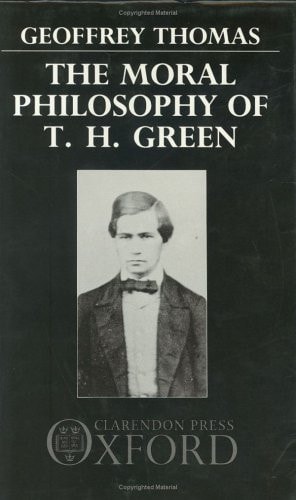
The Moral Philosophy of T.H. Green
0
0
As an Amazon Associate and affiliate partner, Menrva Books earns from qualifying purchases. Learn more
Author Description
Examining Thomas Hill Green's moral philosophy, Thomas defends a radically new perception of Green as an independent thinker rather than a devoted partisan of Kant or Hegel. Green's moral philosophy, argues Thomas, includes a widely misunderstood defense of free will, an innovative model of deliberation that rejects both Kantian and Humean conceptions of practical reason, a barely recognized theory of character, and an account of moral objectivity that involves no dependence on religion--all of which yield a coherent body of moral philosophy that raises important problems neglected in contemporary ethics.
Menrva's Summary
THE THESIS
This work investigates the moral philosophy of T.H. Green to determine whether he functions as an independent thinker rather than a mere derivative of Kantian or Hegelian traditions. Geoffrey Gladstone Thomas utilizes a rigorous analytical framework to re-evaluate Green's contributions to ethics. By dissecting Green's core arguments, the author challenges established academic interpretations and posits that Green's work offers a distinct, coherent system that addresses significant gaps in contemporary ethical discourse.
THE SCOPE MAP
What You Will Find
- A re-examination of Green's defense of free will and its historical reception.
- An analysis of Green's unique model of deliberation, contrasting it with Kantian and Humean frameworks.
- An exploration of Green's theory of character and its role in moral agency.
- An investigation into Green's secular account of moral objectivity.
THE AUTHORITY PERSPECTIVE
Scholars recognize this text as a significant intervention in the study of British Idealism, particularly for its attempt to decouple Green from his continental influences. Readers frequently note the academic density of the prose, which is intended for those already familiar with the history of moral philosophy.
Page Count:
424
Publication Date:
1988-04-14
Publisher:
Oxford University Press
ISBN-10:
0198247885
ISBN-13:
9780198247883
Philosophy
Ethics
Moral Philosophy
Community Tags
Similar Books