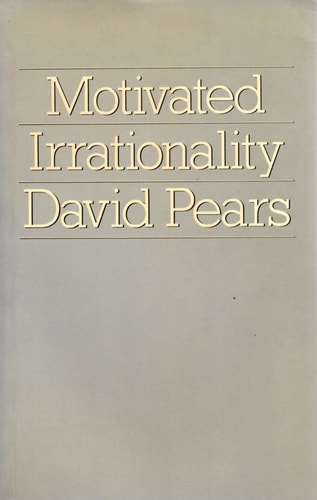
Motivated Irrationality
0
0
As an Amazon Associate and affiliate partner, Menrva Books earns from qualifying purchases. Learn more
Author Description
David Pears has given us an outstandingly lucid and intelligent account of matters of the highest importance. It is the first comprehensive and unified treatment of the paradoxes of irrational thought and irrational action".--John Elster, Times Literary Supplement This book is about self-deception and lack of self-control or wishful thinking and acting against one's own better judgement. Steering a course between the skepticism of philosophers, who find the conscious defiance of reason too paradoxical, and the tolerant empiricism of psychologists, it compares the two kinds of irrationality, and relates the conclusions drawn to the views of Freud, cognitive psychologists, and such philosophers as Aristotle, Anscombe, Hare and Davidson.
Menrva's Summary
THE THESIS
This book investigates the paradoxes of irrational thought and action, specifically focusing on the mechanisms of self-deception and the failure of self-control. David Pears, a distinguished philosopher, constructs a unified framework to analyze how individuals act against their own better judgment. By synthesizing classical philosophical inquiry with modern psychological research, Pears examines the tension between conscious intent and irrational behavior. He evaluates the contributions of thinkers ranging from Aristotle to Freud to provide a rigorous account of why human beings frequently defy the dictates of reason.
THE SCOPE MAP
What You Will Find
- A comparative analysis of self-deception and lack of self-control.
- A critical evaluation of the views of Freud, Aristotle, Anscombe, Hare, and Davidson.
- A synthesis of philosophical skepticism and empirical psychological data.
- A structured examination of wishful thinking and its impact on decision-making.
THE AUTHORITY PERSPECTIVE
Experts and reviewers recognize this work as a foundational and highly lucid treatment of the complexities surrounding irrationality. Readers frequently note the academic rigor of the prose, which successfully bridges the gap between traditional philosophy and cognitive psychology.
Page Count:
256
Publication Date:
1986-03-20
Publisher:
Oxford University Press
ISBN-10:
0198249098
ISBN-13:
9780198249092
Non-Fiction
Psychology
Philosophy
Ethics
Community Tags
Similar Books