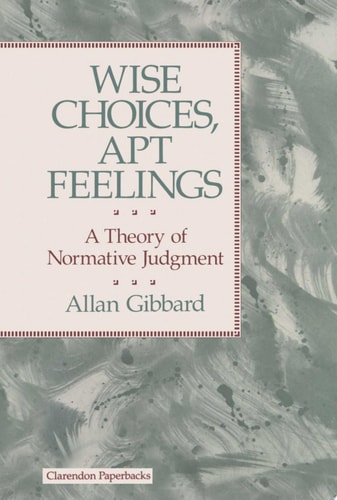
Wise Choices, Apt Feelings
0
0
As an Amazon Associate and affiliate partner, Menrva Books earns from qualifying purchases. Learn more
Author Description
'Choices can be wise or foolish, and feelings can be apt or off the mark.' Since this is how we judge, it would be good to know what content these normative judgements carry. Gibbard offers an answer, and elaborates it. His theory explores what is at issue in narrowly moral questions, and in questions of rational thought and conduct in general. It helps to explain why normative thought and talk so pervade human life, and why our highly social species might have evolved to be gripped by these questions. Gibbard asks how, if his theory is right, we can interpret our normative puzzles, and thus proceed toward finding answers to them. Not available from O.U.P. in the U.S.A., Canada, Japan or the Phillippines.
Menrva's Summary
THE THESIS
What is the semantic content and evolutionary function of normative judgments such as wisdom, foolishness, and emotional aptness? Allan Gibbard, a prominent philosopher, utilizes a naturalistic framework to investigate the nature of normative discourse. He argues that normative judgments are not merely descriptive but serve a specific function in human social coordination, proposing that our capacity for such judgments is an evolved trait that facilitates complex social interaction.
THE SCOPE MAP
What You Will Find
- An analysis of the semantic content of normative terms like 'wise' and 'apt'.
- A theory of normativity that bridges moral philosophy and evolutionary biology.
- An exploration of how normative talk functions within human social structures.
- A methodology for interpreting and resolving normative puzzles through a naturalistic lens.
THE AUTHORITY PERSPECTIVE
Experts recognize this work as a foundational text in contemporary metaethics, particularly for its influence on expressivist theories of normative language. Readers frequently note the academic density of the prose, which requires a strong background in analytic philosophy to fully grasp the author's arguments.
Page Count:
360
Publication Date:
1998-06-04
Publisher:
Clarendon Press
ISBN-10:
0198249845
ISBN-13:
9780198249849
Philosophy
Judgment ethics
Moral Philosophy
Metaethics
Ethics
Rationality
Community Tags
Similar Books