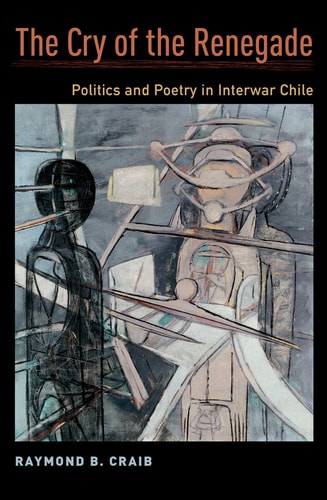
The Cry of the Renegade: Politics and Poetry in Interwar Chile
0
0
As an Amazon Associate and affiliate partner, Menrva Books earns from qualifying purchases. Learn more
Author Description
On October 1, 1920, the city of Santiago, Chile, came to a halt as tens of thousands stopped work and their daily activities to join the funeral procession of José Domingo Gómez Rojas, a 24 year old university student and acclaimed poet. Nicknamed "the firecracker poet" for his incendiary poems, such as "The Cry of the Renegade" Gómez Rojas was a member of the University of Chile's student federation (the FECh) which had come under repeated attack for its critiques of Chile's political system and ruling parties. Government officials accused the FECh's leaders of being advocates for the destruction of the social order, subversives who had the temerity to question national policy making, and insolent youths who did not know their place. Arrested for alleged sedition as part of a five-month-long "prosecution of subversives," Gómez Rojas joined other students and workers in Santiago's prison system. He never left. After two months in police custody, he died in Santiago's asylum, quickly to be reborn as a political martyr for students and workers alike.This microhistory recovers the context within which Gómez Rojas's arrest, imprisonment, and death unfolded and the experiences of men he counted as friends, comrades, colleagues, mentors, and pupils. Fifty years before the much-heralded student movements of 1968, Raymond Craib shows, university students and workers were active political collaborators and radicalized political subjects. In interwar Chile, members of Chile's sizeable working class marched side-by-side with students from the FECh. At the same time, increasingly radicalized university students, as well as former students, workers, and worker-intellectuals, gathered together to talk, read, and find common cause. Members of what Craib calls a "capacious Left" they shared a wide-ranging interest in works of sociology and political theory, a penchant for poetry, and an eclectic embrace of anarchist, socialist, and communist principles and practices. They also shar
Menrva's Summary
THE THESIS
This work investigates the intersection of radical politics and intellectual life in interwar Chile through the lens of the life and death of student poet José Domingo Gómez Rojas. Raymond B. Craib, a historian specializing in Latin American studies, utilizes archival records and contemporary accounts to reconstruct the political climate of 1920s Santiago. He argues that the collaboration between university students and the working class formed a distinct, radicalized political subject that challenged the established national order.
THE SCOPE MAP
What You Will Find
- A detailed microhistory of the 1920 prosecution of subversives in Santiago.
- Analysis of the intellectual exchange between the FECh student federation and the Chilean working class.
- Examination of the influence of anarchist, socialist, and communist ideologies on early 20th-century Chilean youth.
Scope Limits
- The study focuses primarily on the specific political and social context of Santiago rather than a comprehensive national history of Chile.
- It does not provide an exhaustive literary critique of Gómez Rojas's poetry, focusing instead on the political utility and reception of his work.
THE AUTHORITY PERSPECTIVE
Scholars recognize this text as a significant contribution to the study of early 20th-century radical movements in Latin America. Readers frequently note the meticulous archival research and the author's ability to bridge the gap between individual biography and broader socio-political trends.
Page Count:
290
Publication Date:
2019-05-01
Publisher:
Oxford University Press
ISBN-10:
019005378X
ISBN-13:
9780190053789
Politics
History
Biography
Educational Resources
Politics & Government
Social History
Anarchists
Political History
New Used & Rental Textbooks
Central America
Chilean History
South America
World politics
American History
Americas
Community Tags
Similar Books