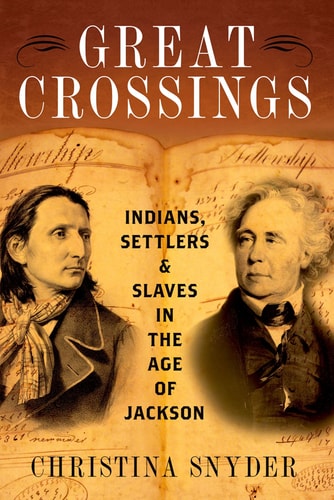
Great Crossings: Indians, Settlers, and Slaves in the Age of Jackson
0
0
As an Amazon Associate and affiliate partner, Menrva Books earns from qualifying purchases. Learn more
Author Description
In Great Crossings: Indians, Settlers, and Slaves in the Age of Jackson, prize-winning historian Christina Snyder reinterprets the history of Jacksonian America. Most often, this drama focuses on whites who turned west to conquer a continent, extending "liberty" as they went. Great Crossings also includes Native Americans from across the continent seeking new ways to assert anciently-held rights and people of African descent who challenged the United States to live up to its ideals. These diverse groups met in an experimental community in central Kentucky called Great Crossings, home to the first federal Indian school and a famous interracial family.Great Crossings embodied monumental changes then transforming North America. The United States, within the span of a few decades, grew from an East Coast nation to a continental empire. The territorial growth of the United States forged a multicultural, multiracial society, but that diversity also sparked fierce debates over race, citizenship, and America's destiny. Great Crossings, a place of race-mixing and cultural exchange, emerged as a battleground. Its history provides an intimate view of the ambitions and struggles of Indians, settlers, and slaves who were trying to secure their place in a changing world. Through deep research and compelling prose, Snyder introduces us to a diverse range of historical actors: Richard Mentor Johnson, the politician who reportedly killed Tecumseh and then became schoolmaster to the sons of his former foes; Julia Chinn, Johnson's enslaved concubine, who fought for her children's freedom; and Peter Pitchlynn, a Choctaw intellectual who, even in the darkest days of Indian removal, argued for the future of Indian nations. Together, their stories demonstrate how this era transformed colonizers and the colonized alike, sowing the seeds of modern America.
Menrva's Summary
THE THESIS
How did the intersection of Native Americans, settlers, and enslaved people at a single Kentucky site reflect the broader racial and political tensions of the Jacksonian era? Historian Christina Snyder utilizes the history of the Great Crossings community to challenge traditional narratives of American westward expansion. By examining the lives of individuals such as Richard Mentor Johnson and Julia Chinn, Snyder argues that the rapid territorial growth of the United States created a volatile, multiracial society where the definitions of citizenship and liberty were constantly contested.
THE SCOPE MAP
What You Will Find
- Analysis of the first federal Indian school established in Kentucky.
- Examination of the interracial family dynamics involving Richard Mentor Johnson and Julia Chinn.
- Exploration of the political and social impact of Indian removal policies.
- Primary source research detailing the experiences of Choctaw intellectuals and enslaved individuals.
Scope Limits
- The study is geographically centered on the Great Crossings community in Kentucky.
- The narrative focuses specifically on the Jacksonian period rather than the entirety of 19th-century American history.
THE AUTHORITY PERSPECTIVE
Historians and scholars frequently cite this work for its ability to integrate marginalized voices into the standard narrative of American expansion. Readers often note that the text provides a nuanced, localized perspective on national policy shifts during the early 19th century.
Page Count:
418
Publication Date:
2019-07-15
Publisher:
Oxford University Press
ISBN-10:
0190053828
ISBN-13:
9780190053826
History
Social History
Military
Slavery
Nineteenth century
New Used & Rental Textbooks
Americas
United States
Native American
Educational Resources
Community Tags
Other Editions(2)
Similar Books


Reader Comments
Share Your Thoughts
No comments yet. Be the first to share your thoughts!