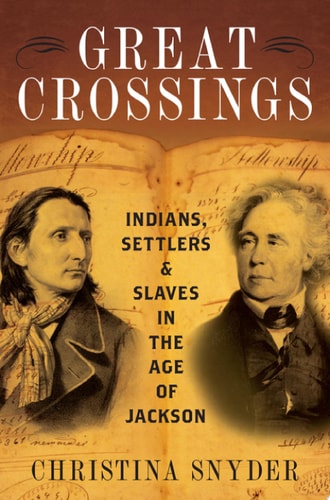
Great Crossings: Indians, Settlers, and Slaves in the Age of Jackson
0
0
As an Amazon Associate and affiliate partner, Menrva Books earns from qualifying purchases. Learn more
Author Description
In Great Crossings: Indians, Settlers, and Slaves in the Age of Jackson, prize-winning historian Christina Snyder reinterprets the history of Jacksonian America. Most often, this drama focuses on whites who turned west to conquer a continent, extending "liberty" as they went. Great Crossings also includes Native Americans from across the continent seeking new ways to assert anciently-held rights and people of African descent who challenged the United States to live up to its ideals. These diverse groups met in an experimental community in central Kentucky called Great Crossings, home to the first federal Indian school and a famous interracial family. Great Crossings embodied monumental changes then transforming North America. The United States, within the span of a few decades, grew from an East Coast nation to a continental empire. The territorial growth of the United States forged a multicultural, multiracial society, but that diversity also sparked fierce debates over race, citizenship, and America's destiny. Great Crossings, a place of race-mixing and cultural exchange, emerged as a battleground. Its history provides an intimate view of the ambitions and struggles of Indians, settlers, and slaves who were trying to secure their place in a changing world. Through deep research and compelling prose, Snyder introduces us to a diverse range of historical actors: Richard Mentor Johnson, the politician who reportedly killed Tecumseh and then became schoolmaster to the sons of his former foes; Julia Chinn, Johnson's enslaved concubine, who fought for her children's freedom; and Peter Pitchlynn, a Choctaw intellectual who, even in the darkest days of Indian removal, argued for the future of Indian nations. Together, their stories demonstrate how this era transformed colonizers and the colonized alike, sowing the seeds of modern America.
Menrva's Summary
THE THESIS
This book investigates how the experimental community of Great Crossings, Kentucky, served as a microcosm for the racial, political, and social tensions defining the Jacksonian era. Christina Snyder, a historian specializing in the American South and Indigenous history, utilizes archival records and personal narratives to challenge traditional narratives of westward expansion. She argues that the interactions between Native Americans, white settlers, and enslaved people at this specific site reveal the complex, often contradictory nature of American identity and citizenship during a period of rapid territorial growth.
THE SCOPE MAP
What You Will Find
- An analysis of the first federal Indian school and its role in assimilationist policy.
- Biographical examinations of Richard Mentor Johnson, Julia Chinn, and Peter Pitchlynn.
- A study of the intersectional dynamics between race, slavery, and federal Indian policy in the early 19th century.
- Historical evidence regarding the development of multiracial communities in the American frontier.
THE AUTHORITY PERSPECTIVE
Historians and scholars of the Jacksonian period recognize this work for its nuanced approach to the intersection of Indigenous and African American experiences. Readers frequently note the clarity of the prose and the author's ability to synthesize complex social dynamics into a coherent, localized narrative.
Page Count:
416
Publication Date:
2017-01-01
Publisher:
Oxford University Press
ISBN-10:
0199399085
ISBN-13:
9780199399086
Biography
History
United States
Social History
Southern States
America history
Community Life
American History
African Americans
Kentucky history
Special Topics
Community Tags
Other Editions(2)
Similar Books

Reader Comments
Share Your Thoughts
No comments yet. Be the first to share your thoughts!