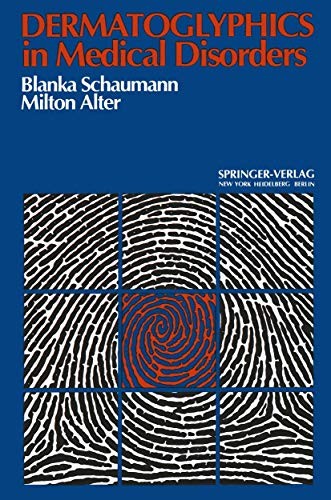
Dermatoglyphics in Medical Disorders
0
0
As an Amazon Associate and affiliate partner, Menrva Books earns from qualifying purchases. Learn more
Author Description
The skin on the fingertips and palmar and plantar surfaces of man is not smooth. It is grooved by curious ridges, which form a variety of configurations. These ridge configurations have attracted the at tention of laymen for millenia. They have also evoked the serious interest of scientists for more than three centuries. The anatomist Bidloo provided a description of ridge detail in the seventeenth cen tury. Since then, additional information has been added by anthro pologists, biologists, and geneticists. For the last century, the fact that each individual's ridge configurations are unique has been uti lized as a means of personal identification especially by law enforce ment officials. Widespread medical interest in epidermal ridges de veloped only in the last several decades when it became apparent that many patients with chromosomal aberrations had unusual ridge formations. Inspection of skin ridges, therefore, promised to provide a simple, inexpensive means for determining whether a given patient had a particular chromosomal defect. However, the promise was only partially fulfilled because of the inherent variability of skin ridge configurations. It was possible to draw conclusions about ridge ab normalities in groups of patients but not always in a given individual. Patients and clinicians became somewhat disenchanted with the clinical value of studying ridges.
Menrva's Summary
THE THESIS
The unique patterns of epidermal ridges hold clues to underlying genetic and chromosomal abnormalities. This book explores the historical and scientific interest in dermatoglyphics, the study of skin ridge patterns. It details how these patterns, known for their uniqueness and use in identification, became a focus for medical research due to observed correlations with chromosomal aberrations. The text discusses the initial promise of dermatoglyphics as a simple diagnostic tool for genetic defects and the subsequent challenges and limitations encountered due to the inherent variability of ridge configurations, which made individual diagnosis difficult.
THE SCOPE MAP
- Historical overview of dermatoglyphics from ancient observations to modern scientific study.
- Detailed descriptions of ridge configurations and their formation.
- The use of dermatoglyphics in personal identification, particularly by law enforcement.
- The development of medical interest in epidermal ridges, especially concerning chromosomal aberrations.
- Case studies and research findings linking unusual ridge formations to specific medical disorders.
- The inherent variability of skin ridge patterns and its impact on diagnostic accuracy.
- The limitations and challenges in using dermatoglyphics for individual diagnosis of medical conditions.
- The potential and future directions for dermatoglyphic research in medicine.
THE AUTHORITY PERSPECTIVE
The book appears to offer a comprehensive review of dermatoglyphics, tracing its historical significance and scientific exploration. It addresses the initial excitement surrounding its potential as a diagnostic tool for genetic disorders and the subsequent disillusionment due to variability issues. The text likely provides a balanced perspective on the utility and limitations of studying skin ridges in a clinical context. This work seems to be aimed at researchers and clinicians interested in the intersection of genetics, dermatology, and medical diagnostics.
Page Count:
270
Publication Date:
2012-01-01
ISBN-10:
364251622X
ISBN-13:
9783642516221
Non-Fiction
Science
Anthropology
Genetics
Biology
Dermatology
Community Tags
Similar Books