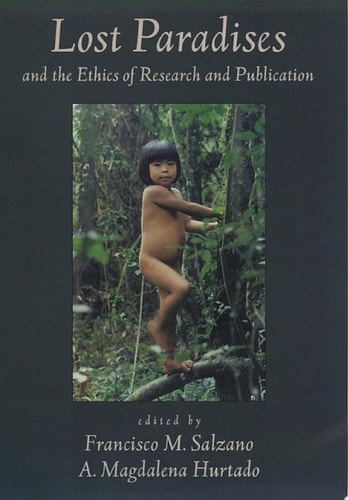
Lost Paradises and the Ethics of Research and Publication
0
0
As an Amazon Associate and affiliate partner, Menrva Books earns from qualifying purchases. Learn more
Author Description
In 2000, the world of anthropology was rocked by a high-profile debate over the fieldwork performed by two prominent anthropologists, Napoleon Chagnon and James V. Neel, among the Yanamamo tribe of South America. The controversy was fueled by the publication of Patrick Tierney's incendiary Darkness in El Dorado which accused Chagnon of not only misinterpreting but actually inciting some of the violence he perceived among these "fierce people". Tierney also pointed the finger at Neel as the unwitting agent of a deadly measles outbreak.Attracting a firestorm of attention, Tierney's book went straight to the heart of anthropology's most pressing questions: What are the right ways to study a tribal people? How can scientists avoid unduly influencing those among whom they live? What guidelines should govern the interactions - economic, social, medical, and sexual - between a scientist in the field and the people being studied?This volume represents anthropology's thoughtful, measured reply to the issues raised by this heated controversy. Placing the dispute within the context of ongoing debates over the ethics of biomedical research among human populations, the contributors to this volume discuss how the interaction between investigators and their subjects can most sensibly be governed. They consider the responsibility of the media in disseminating anti-scientific and pseudo-scientific views, and how scientists might best educate journalists to enable them to effectively educate others.In the wake of what was widely construed as a major scientific scandal, this landmark volume lays out in detail the principles and ground rules of anthropological and scientific fieldwork.
Menrva's Summary
THE THESIS
This volume investigates the ethical boundaries and professional responsibilities inherent in anthropological fieldwork, specifically in response to the controversy surrounding research conducted among the Yanomami people. The authors, A. Magdalena Hurtado and Francisco M. Salzano, curate a collection of expert perspectives to address the intersection of biomedical research, human rights, and scientific integrity. The text evaluates the historical context of the 'Darkness in El Dorado' scandal to establish a framework for future cross-cultural research practices.
THE SCOPE MAP
What You Will Find
- Analysis of the 2000 controversy involving Napoleon Chagnon and James V. Neel.
- Ethical guidelines for interactions between researchers and indigenous populations.
- Discussions on the role of media in reporting scientific findings.
- Principles for managing economic, social, and medical relationships in the field.
Scope Limits
- The text does not provide a definitive legal verdict on the specific allegations against Chagnon and Neel.
- It does not cover the entirety of anthropological history, focusing primarily on the ethics of biomedical and ethnographic fieldwork.
THE AUTHORITY PERSPECTIVE
Experts recognize this volume as a critical response to the crisis of representation and ethics in late 20th-century anthropology. The text is frequently cited by scholars as a foundational resource for establishing professional standards in field research.
Page Count:
248
Publication Date:
2003-01-01
Publisher:
Oxford University Press
ISBN-10:
0190287969
ISBN-13:
9780190287962
Science
Anthropology
Ethics
Sociology
Cultural Anthropology
South America
Academic