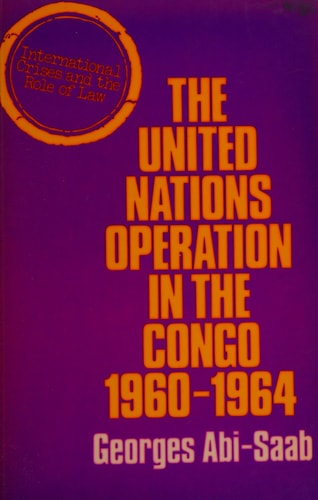
The United Nations Operation in the Congo, 1960-1964: International Crisis and the Role of Law
0
0
As an Amazon Associate and affiliate partner, Menrva Books earns from qualifying purchases. Learn more
Author Description
This study illustrates the growing political role of the United Nations in the 1960s, and also the difficulty of implementing decisions on the spot when faced with unexpected developments and obstacles which appeared insurmountable. The work also traces the role of law in influencing the decisions taken in a situation of tremendous complexity.
Menrva's Summary
THE THESIS
This study examines the evolving political mandate and legal constraints of the United Nations during the intervention in the Congo between 1960 and 1964. Georges Abi-Saab, a noted scholar in international law, utilizes primary documentation and institutional records to analyze how the UN navigated the volatile transition from colonial rule to independence. The author argues that the organization faced significant operational challenges that forced a re-evaluation of its peacekeeping framework and legal authority in real-time crisis management.
THE SCOPE MAP
What You Will Find
- Analysis of the legal framework governing UN peacekeeping operations in the 1960s.
- Detailed examination of the political obstacles encountered during the Congo crisis.
- Case studies on the implementation of Security Council resolutions in unstable environments.
- Evaluation of the interplay between international law and diplomatic decision-making.
THE AUTHORITY PERSPECTIVE
Experts recognize this work as a foundational text for understanding the legal complexities of early UN peacekeeping missions. Scholars frequently cite the book for its rigorous analysis of the institutional limitations faced by international organizations during post-colonial conflicts.
Page Count:
224
Publication Date:
1979-01-04
Publisher:
Oxford University Press
ISBN-10:
0198253230
ISBN-13:
9780198253235
History
Congo Democratic Republic
Law
International relations
African history
United Nations
Community Tags
Similar Books