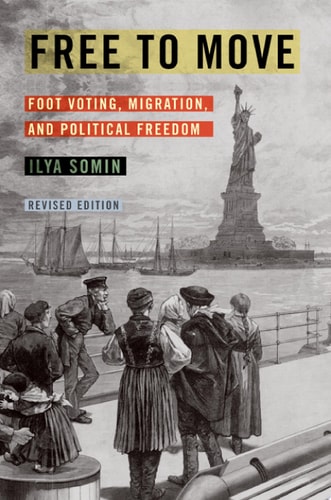
Free to Move: Foot Voting, Migration, and Political Freedom
0
0
As an Amazon Associate and affiliate partner, Menrva Books earns from qualifying purchases. Learn more
Author Description
Ballot box voting is often considered the essence of political freedom. But it has two major shortcomings: individual voters have little chance of making a difference, and they also face strong incentives to remain ignorant about the issues at stake. "Voting with your feet," however, avoids both of these pitfalls and offers a wider range of choices. In Free to Move, Ilya Somin explains how broadening opportunities for foot voting can greatly enhance political liberty for millions of people around the world.People can vote with their feet through international migration, by choosing where to live within a federal system, and by making decisions in the private sector. These three types of foot voting are rarely considered together, but Somin explains how they have important common virtues and can be mutually reinforcing. He contends that all forms of foot voting should be expanded and shows how both domestic constitutions and international law can be structured to increase opportunities for foot voting while mitigating possible downsides.Somin addresses a variety of common objections to expanded migration rights, including claims that the "self-determination" of natives requires giving them the power to exclude migrants, and arguments that migration is likely to have harmful side effects, such as undermining political institutions, overburdening the welfare state, increasing crime and terrorism, and spreading undesirable cultural values. While these objections are usually directed at international migration, Somin shows how a consistent commitment to such theories would also justify severe restrictions on domestic freedom of movement. That implication is an additional reason to be skeptical of these rationales for exclusion. By making a systematic case for a more open world, Free to Move challenges conventional wisdom on both the left and the right.Named one of the Best Nonfiction Books of 2020 by Stephen Carter, Yale Law School, Bloomberg.
Menrva's Summary
THE THESIS
Ilya Somin investigates whether expanding opportunities for 'foot voting'—the act of choosing one's political environment through migration—can serve as a more effective mechanism for political freedom than traditional ballot box voting. Somin, a professor of law at George Mason University, utilizes a framework of political economy and legal theory to argue that individual agency is better expressed through mobility than through the marginal impact of a single vote. He posits that by integrating international migration, domestic federalism, and private sector choice, societies can create a more robust system of liberty that addresses the inherent limitations of democratic participation.
THE SCOPE MAP
What You Will Find
- Analysis of three distinct modes of foot voting: international migration, internal federal movement, and private sector decision-making.
- A legal and constitutional framework for protecting and expanding freedom of movement.
- Rebuttals to common arguments against migration, including concerns regarding national self-determination, welfare state stability, and cultural preservation.
Scope Limits
- The text does not provide a comprehensive guide to immigration law or specific visa processing procedures.
- It does not focus on the psychological motivations of individual migrants, but rather on the systemic political and economic implications of their movement.
THE AUTHORITY PERSPECTIVE
Experts and reviewers frequently highlight the book as a rigorous, interdisciplinary contribution to political theory that challenges conventional partisan narratives on both the left and the right. Readers note the academic density of the prose, which is balanced by a clear, logical structure that makes complex legal and economic arguments accessible to an informed general audience.
Page Count:
272
Publication Date:
2020-05-13
Publisher:
Oxford University Press
ISBN-10:
0190054581
ISBN-13:
9780190054588
Philosophy
Economics
Politics
Immigration
Social Science
New Used & Rental Textbooks
Migration
Law
Professional Career & Trade
Politics & Government
Constitutional Law
General
Public Policy
Administrative Law
Specific Topics
Community Tags
Other Editions(2)

Similar Books





Reader Comments
Share Your Thoughts
No comments yet. Be the first to share your thoughts!