Learning from Six Philosophers: Descartes, Spinoza, Leibniz, Locke, Berkeley, Hume
0
0
As an Amazon Associate and affiliate partner, Menrva Books earns from qualifying purchases. Learn more
Author Description
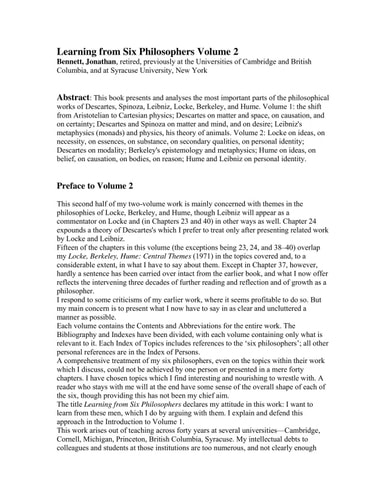
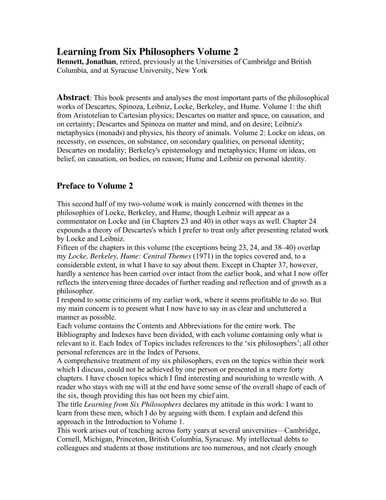
This illuminating work explores six great thinkers of the early modern period: Descartes, Spinoza, Leibniz, Locke, Berkeley, and Hume. While not neglecting the historical setting of each, its focus is on the words they wrote. As in all of Bennett's works, it addresses philosophy as philosophy, not as museum exhibit, and it offers a close and demanding attention to textual details. For newcomers to the early modern scene, this clearly written work is an excellent introduction, and for those already in the know, it provides tools to argue with the great philosophers of the past, treating them as colleagues, antagonists, students, and teachers.
Menrva's Summary
THE THESIS
How can contemporary readers engage with the foundational texts of early modern philosophy as active, living arguments rather than static historical artifacts? Jonathan Bennett, a prominent philosopher known for his rigorous analytical approach, provides a framework for evaluating the core propositions of six major thinkers. By prioritizing the internal logic and textual evidence of these philosophers over mere historical context, Bennett invites readers to treat these historical figures as intellectual peers engaged in ongoing debate.
THE SCOPE MAP
What You Will Find
- Detailed philosophical analysis of Descartes, Spinoza, Leibniz, Locke, Berkeley, and Hume.
- Methodologies for close textual reading and logical reconstruction of arguments.
- Critical evaluation of early modern metaphysical and epistemological claims.
- Tools for constructing counter-arguments against established philosophical positions.
THE AUTHORITY PERSPECTIVE
Experts and students alike recognize this work as a standard, highly accessible entry point into early modern philosophy. Readers frequently note the clarity of Bennett's prose, which manages to maintain academic rigor while remaining approachable for those new to the subject.
Page Count:
400
Publication Date:
2001-05-10
Publisher:
Clarendon Press
ISBN-10:
0198250924
ISBN-13:
9780198250920
Philosophy
Non-Fiction
Philosophers