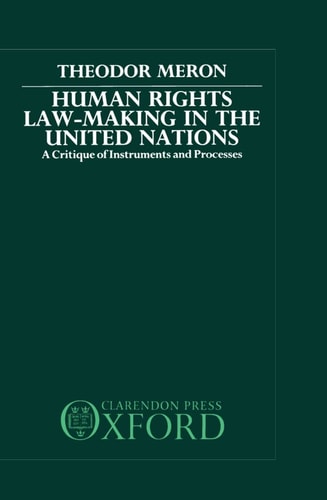
Human Rights Law-Making in the United Nations: A Critique of Instruments and Processes
0
0
As an Amazon Associate and affiliate partner, Menrva Books earns from qualifying purchases. Learn more
Author Description
Examining in detail the International Convention on the Elimination of All Forms of Racial Discrimination, the Convention on the Elimination of All Forms of Discrimination Against Women, and the International Covenant on Civil and Political Rights, this book studies and critiques the methods employed by the United Nations in adopting instruments to protect human rights. Pointing to many examples of unclear provisions and of overlap and conflict within a single instrument or between instruments, Meron concludes that the present system of law-making is inadequate and suggests some reforms both of the institutions and of the process itself.
Menrva's Summary
THE THESIS
This book investigates the systemic inadequacies within the United Nations' human rights law-making processes and the resulting inconsistencies in international legal instruments. Theodor Meron, a distinguished scholar and expert in international law, utilizes his extensive background to analyze the drafting and implementation of major human rights treaties. He argues that the current methodology for creating international standards is flawed, leading to fragmented and often contradictory legal frameworks that undermine the efficacy of human rights protections.
THE SCOPE MAP
What You Will Find
- Detailed analysis of the International Convention on the Elimination of All Forms of Racial Discrimination.
- Critical review of the Convention on the Elimination of All Forms of Discrimination Against Women.
- Examination of the International Covenant on Civil and Political Rights.
- Proposed institutional and procedural reforms to improve international law-making.
THE AUTHORITY PERSPECTIVE
Legal scholars and practitioners frequently cite this work as a foundational critique of the procedural shortcomings inherent in international treaty drafting. The text is noted for its rigorous academic density and its practical focus on the intersection of institutional policy and legal clarity.
Page Count:
350
Publication Date:
1987-02-19
Publisher:
Oxford University Press
ISBN-10:
0198255497
ISBN-13:
9780198255499
Human rights
Law
International relations
United Nations
Community Tags
Similar Books