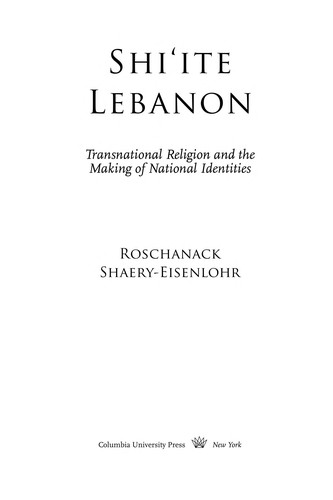
Shiʻite Lebanon
0
0
As an Amazon Associate and affiliate partner, Menrva Books earns from qualifying purchases. Learn more
Author Description
By recasting the relationship between religion and nationalism in the Middle East, Roschanack Shaery-Eisenlohr proposes a new framework for understanding Shi'ite politics in Lebanon. Her study draws on a variety of untapped sources, reconsidering not only the politics of the established leadership of Shi'ites but also institutional and popular activities of identity production. Shaery-Eisenlohr traces current Shi'ite politics of piety and authenticity to the coexistence formula in Lebanon and argues that engaging in the discourses of piety and coexistence is a precondition to cultural citizenship in Lebanon. As she demonstrates, debates over the nature of Christianity and Islam and Christian-Muslim dialogue are in fact intertwined with power struggles at the state level. Since the 1970s, debates in the transnational Shi'ite world have gradually linked Shi'ite piety with the support of the Palestinian cause. Iran's religious elite has backed this piety project in multiple ways, but in doing so it has assisted in the creation of a variety of Lebanese Shi'ite nationalisms with competing claims to religious and national authenticity. Shaery-Eisenlohr argues that these ties to Iran have in fact strengthened the position of Lebanese Shi'ites by providing, as is recognized, economic, military, and ideological support for Hizbullah, as well as by compelling Lebanese Shi'ites to foreground the Lebanese components of their identity more forcefully than ever before.
Menrva's Summary
THE THESIS
This book reconfigures the understanding of Shi'ite politics in Lebanon by examining the intricate relationship between religion and nationalism. Roschanack Shaery-Eisenlohr's study utilizes previously untapped sources to analyze both the established leadership and the grassroots activities of Shi'ite identity formation. The work posits that contemporary Shi'ite piety and authenticity discourses are rooted in Lebanon's coexistence formula, making engagement with these discussions a prerequisite for cultural citizenship. The author demonstrates how debates concerning Christianity, Islam, and interfaith dialogue are intrinsically linked to state-level power struggles, with transnational Shi'ite discussions since the 1970s increasingly connecting piety to support for the Palestinian cause.
THE SCOPE MAP
- Analysis of untapped primary sources on Lebanese Shi'ite politics.
- Reconsideration of institutional and popular activities in identity production.
- Tracing current Shi'ite politics of piety and authenticity to Lebanon's coexistence formula.
- Intertwining of debates on Christianity, Islam, and dialogue with state-level power struggles.
- Examination of the link between Shi'ite piety and support for the Palestinian cause since the 1970s.
- The role of Iran's religious elite in supporting Lebanese Shi'ite piety projects.
- Argument that ties to Iran have strengthened Lebanese Shi'ites by supporting Hizbullah and foregrounding Lebanese identity components.
THE AUTHORITY PERSPECTIVE
This study is recognized for its novel framework in understanding Shi'ite politics in Lebanon, drawing on a diverse range of previously unexamined sources. Scholars have noted its detailed analysis of both leadership and popular movements in shaping Shi'ite identity. The book's argument connecting piety, coexistence, and cultural citizenship is considered a significant contribution to the field. Its exploration of the transnational Shi'ite world and the influence of external actors like Iran provides crucial context for contemporary Lebanese political dynamics.
Page Count:
288
Publication Date:
2008-01-01
ISBN-10:
0231144261
ISBN-13:
9780231144261
Science
Religion
Politics
Non-Fiction
History
Sociology
Lebanese History
Community Tags
Similar Books