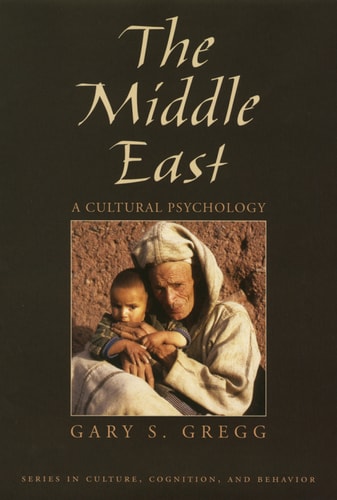
The Middle East: A Cultural Psychology
0
0
As an Amazon Associate and affiliate partner, Menrva Books earns from qualifying purchases. Learn more
Author Description
For over a decade the Middle East has monopolized news headlines in the West. Journalists and commentators regularly speculate that the region's turmoil may stem from the psychological momentum of its cultural traditions or of a "tribal" or "fatalistic" mentality. Yet few studies of the region's cultural psychology have provided a critical synthesis of psychological research on Middle Eastern societies. Drawing on autobiographies, literary works, ethnographic accounts, and life-history interviews, The Middle East: A Cultural Psychology, offers the first comprehensive summary of psychological writings on the region, reviewing works by psychologists, anthropologists, and sociologists that have been written in English, Arabic, and French. Rejecting stereotypical descriptions of the "Arab mind" or "Muslim mentality,' Gary Gregg adopts a life-span- development framework, examining influences on development in infancy, early childhood, late childhood, and adolescence as well as on identity formation in early and mature adulthood. He views patterns of development in the context of recent work in cultural psychology, and compares Middle Eastern patterns less with Western middle class norms than with those described for the region's neighbors: Hindu India, sub-Saharan Africa, and the Mediterranean shore of Europe. The research presented in this volume overwhelmingly suggests that the region's strife stems much less from a stubborn adherence to tradition and resistance to modernity than from widespread frustration with broken promises of modernization--with the slow and halting pace of economic progress and democratization. A sophisticated account of the Middle East's cultural psychology, The Middle East provides students, researchers, policy-makers, and all those interested in the culture and psychology of the region with invaluable insight into the lives, families, and social relationships of Middle Easterners as they struggle to reconcile the lure of Westernized life-style
Menrva's Summary
THE THESIS
This book investigates whether the political and social turmoil in the Middle East is a product of inherent cultural or psychological traits or a result of broader socio-economic conditions. Gary S. Gregg, a scholar in cultural psychology, synthesizes a wide array of research to challenge common Western stereotypes regarding the region. By applying a life-span development framework, he examines how individuals in Middle Eastern societies form identities and navigate social relationships from infancy through adulthood. The central argument posits that regional strife is primarily driven by frustration with stalled modernization and economic stagnation rather than an innate resistance to change.
THE SCOPE MAP
What You Will Find
- A synthesis of psychological, anthropological, and sociological research from English, Arabic, and French sources.
- A life-span development framework covering infancy, childhood, adolescence, and adulthood.
- Comparative analysis between Middle Eastern patterns and those of Hindu India, sub-Saharan Africa, and Mediterranean Europe.
Scope Limits
- The text does not provide a comprehensive political history of every individual nation in the region.
- It avoids speculative generalizations about a singular 'Arab mind' or 'Muslim mentality.'
THE AUTHORITY PERSPECTIVE
Experts and academics recognize this work as a significant contribution to the field of cultural psychology for its rigorous rejection of reductionist stereotypes. Readers frequently note the academic density of the prose, which makes it a valuable resource for researchers and policy-makers seeking a nuanced understanding of the region.
Page Count:
470
Publication Date:
2005-01-01
Publisher:
Oxford University Press
ISBN-10:
0190291443
ISBN-13:
9780190291440
History
Psychology
Personality And Culture
Social Science
Anthropology
Comparative Politics
Sociology
Middle Eastern
Community Tags
Similar Books