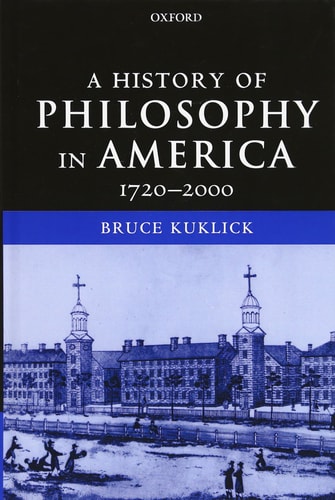
A History of Philosophy in America, 1720-2000
0
0
As an Amazon Associate and affiliate partner, Menrva Books earns from qualifying purchases. Learn more
Author Description
Ranging from Joseph Bellamy to Hilary Putnam, and from early New England Divinity Schools to contemporary university philosophy departments, historian Bruce Kuklick recounts the story of the growth of philosophical thinking in the United States.Readers will explore the thought of early American philosophers such as Jonathan Edwards and John Witherspoon and will see how the political ideas of Benjamin Franklin, Thomas Paine and Thomas Jefferson influenced philosophy in colonial America. Kuklick discusses The Transcendental Club (members Henry David Thoreau, Ralph Waldo Emerson) and describes the rise of pragmatism centered on Metaphysical Club of Cambridge (and members William James, Oliver Wendell Holmes, and Charles Peirce). He examines the profound impact Darwinism had on American philosophy and looks at Idealists such as the Kantian Josiah Royce and the Hegelian John Dewey. The book shows how, in the twentieth century, the Nazi conquest of Europe unleashed a flood of European intellectuals onto these shores, including such major thinkers as Theodore Adorno, Erich Fromm, Rudolph Carnap, and Alfred Tarski. Finally, Kuklick examines the contributions of such contemporary philosophers as Sidney Hook and Willard Quine and such books as John Rawl's A Theory of Justice and Herbert Marcuse's One Dimensional Man. Kuklick pulls no punches in portraying the state of American philosophy today and its contested role in the intellectual life of the nation and the world.The range of philosophical thought in our nation's history has been great, from Edwards's Religious Affections to Kuhn's The Structure of Scientific Revolutions, and Bruce Kuklick has captured it all in a book that blends intricate details with sweeping vision.
Menrva's Summary
THE THESIS
How has the trajectory of philosophical thought in the United States evolved from the colonial era to the dawn of the twenty-first century? Bruce Kuklick, a noted historian of American intellectual life, provides a comprehensive examination of the institutional and individual developments that shaped the American philosophical landscape. By tracing the transition from early divinity schools to modern university departments, the author argues that American philosophy is a product of shifting social, political, and international influences. The text synthesizes the contributions of diverse thinkers, ranging from colonial theologians to twentieth-century pragmatists and European émigrés, to map the maturation of the discipline.
THE SCOPE MAP
What You Will Find
- A chronological survey of American philosophical development from 1720 to 2000.
- Analysis of the influence of religious institutions, the Transcendentalist movement, and the rise of pragmatism.
- Examination of the impact of Darwinism and the influx of European intellectuals during the mid-twentieth century.
- Critical assessment of contemporary figures such as Sidney Hook, Willard Quine, and John Rawls.
THE AUTHORITY PERSPECTIVE
Experts recognize this work as a comprehensive, high-level synthesis of American intellectual history that effectively bridges the gap between theology and secular academic philosophy. Readers frequently note the density of the prose and the author's willingness to offer critical assessments of the current state of the field.
Page Count:
346
Publication Date:
2002-04-25
Publisher:
Clarendon Press
ISBN-10:
0198250312
ISBN-13:
9780198250319
History
Non-Fiction
Philosophy
American History
Philosophy history
Intellectual History
Community Tags
Similar Books














