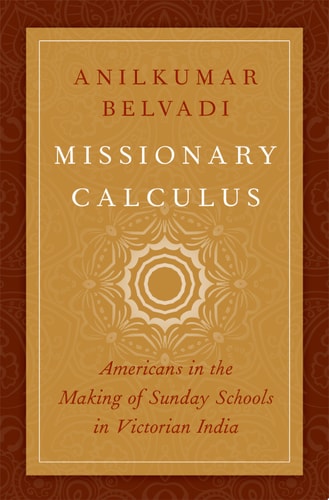
Missionary Calculus: Americans in the Making of Sunday Schools in Victorian India
0
0
As an Amazon Associate and affiliate partner, Menrva Books earns from qualifying purchases. Learn more
Author Description
How are religious educational institutions built? In histories of evangelical institution-building in the Victorian Indian colonial period (1858-1901), this question has mostly been addressed from the perspective of the religious ends that Christian missionaries sought to achieve and the ideological obstacles they encountered. This may be called the 'values' approach. Missionary Calculus sets this aside and examines, instead, the most routine transactions of missionaries in building an evangelical institution, the Sunday school. Missionaries daily struggled with and acted upon certain questions: How shall we acquire land and money to set up such schools? What methods shall we employ to attract students? What curriculum, books, and classroom materials shall we use? How shall we tune our hymns? Shall we employ non-Christians to teach in Christian Sunday schools? The makers of colonial Sunday schools focused obsessively on the means, the material and symbolic resources, with which they felt they could achieve certain immediate objectives. Such a transactional or 'instrumental' approach resulted in stated religious 'values' being insidiously compromised. Using insights from classical Weberian sociology, and through a close scrutiny of missionary means, this book shows how the success or failure of meeting evangelical ends may be assessed.With extensive archival research, chiefly on American missionaries in colonial India, this work examines the formation of Sunday schools at the point of transnational, intercultural contact. Readers interested in religion, education, and colonial history should find the matter, method, outcomes, and narration of Missionary Calculus new and thought-provoking.
Menrva's Summary
THE THESIS
This book investigates how the routine, transactional methods employed by American missionaries in Victorian India shaped the development and ultimate efficacy of Sunday school institutions. Anilkumar Belvadi, drawing on classical Weberian sociology, shifts the analytical focus from the ideological goals of evangelicalism to the practical, material, and symbolic resources utilized by missionaries. By examining the daily operational struggles—such as land acquisition, curriculum selection, and staffing—the author argues that an instrumental approach often compromised the very religious values the missionaries intended to promote.
THE SCOPE MAP
What You Will Find
- Analysis of evangelical institution-building in colonial India between 1858 and 1901
- Application of Weberian sociological frameworks to missionary activities
- Examination of transnational and intercultural contact points in educational settings
Scope Limits
- The study focuses primarily on American missionaries rather than the broader spectrum of European colonial actors
- The analysis is restricted to the specific timeframe of the Victorian Indian colonial period
THE AUTHORITY PERSPECTIVE
Scholars in colonial history and religious studies recognize this work as a significant contribution to understanding the material realities of missionary efforts. Readers frequently note the academic density of the prose and the depth of the archival research presented by the author.
Page Count:
258
Publication Date:
2019-01-01
Publisher:
Oxford University Press
ISBN-10:
0190052449
ISBN-13:
9780190052447
History
Religion
Soft Sci-fi
Schools & Teaching
World
Social Sciences - Religion - Christianity
India
Religious
Sociology
Cultural
Asia
Education Teaching
General
Anthropology - Cultural
Social History
Education Theory
Education
New Used & Rental Textbooks
Career education
Community Tags
Similar Books