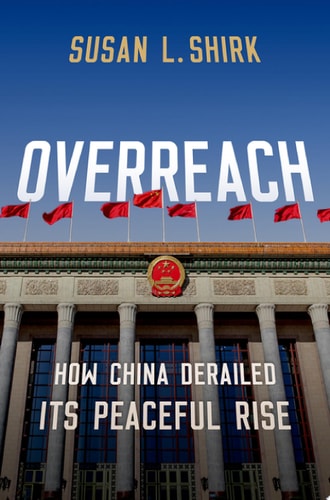
Overreach: How China Derailed Its Peaceful Rise
0
0
As an Amazon Associate and affiliate partner, Menrva Books earns from qualifying purchases. Learn more
Author Description
Winner, The Lionel Gelber PrizeSilver Medal, Arthur Ross Book AwardFor decades, China's rise to power was characterized by its reassurance that this rise would be peaceful. Then, as Susan L. Shirk, shows in this sobering, clear-eyed account of China today, something changed.For three decades after Mao's death in 1976, China's leaders adopted a restrained approach to foreign policy. They determined that any threat to their power, and that of the Chinese Communist Party, came not from abroad but from within―a conclusion cemented by the 1989 Tiananmen crisis. To facilitate the country's inexorable economic ascendence, and to prevent a backlash, they reassured the outside world of China's peaceful intentions.Then, as Susan Shirk shows in this illuminating, disturbing, and utterly persuasive new book, something changed. China went from fragile superpower to global heavyweight, threatening Taiwan as well as its neighbors in the South China Sea, tightening its grip on Hong Kong, and openly challenging the United States for preeminence not just economically and technologically but militarily. China began to overreach. Combining her decades of research and experience, Shirk, one of the world's most respected experts on Chinese politics, argues that we are now fully embroiled in a new cold war.To explain what happened, Shirk pries open the "black box" of China's political system and looks at what derailed its peaceful rise. As she shows, the shift toward confrontation began in the mid-2000s under the mild-mannered Hu Jintao, first among equals in a collective leadership. As China's economy boomed, especially after the Global Financial Crisis of 2008, Hu and the other leaders lost restraint, abetting aggression toward the outside world and unchecked domestic social control. When Xi Jinping took power in 2012, he capitalized on widespread official corruption and open splits in the leadership to make the case for more concentrated power at the top. In the decade following, and t
Menrva's Summary
THE THESIS
This book investigates the internal political shifts that caused China to abandon its strategy of a peaceful rise in favor of aggressive global posturing. Susan L. Shirk, a veteran expert on Chinese politics, utilizes her extensive research and experience to analyze how the Chinese Communist Party transitioned from a policy of restraint to one of confrontation. She argues that the erosion of collective leadership and the consolidation of power under Xi Jinping fundamentally altered China's trajectory on the world stage.
THE SCOPE MAP
What You Will Find
- Analysis of Chinese foreign policy from the post-Mao era to the present.
- Examination of the internal political dynamics within the Chinese Communist Party.
- Evaluation of the impact of the 2008 Global Financial Crisis on Chinese leadership.
- Assessment of China's current geopolitical stance toward Taiwan, Hong Kong, and the United States.
Scope Limits
- The text focuses primarily on high-level political decision-making rather than grassroots social movements.
- It does not provide a comprehensive economic forecast for the next decade.
THE AUTHORITY PERSPECTIVE
Experts recognize this work as a significant contribution to the understanding of contemporary Chinese governance and its implications for global stability. Readers frequently note the clarity of the author's analysis despite the inherent complexity of the Chinese political system.
Page Count:
424
Publication Date:
2022-10-18
Publisher:
Oxford University Press
ISBN-10:
0190068515
ISBN-13:
9780190068516
History
Politics
Elections & Political Process
Geopolitics
International relations
Politics & Government
Asia
China
World
Asian
Social History
Foreign Policy
World politics
Community Tags
Similar Books