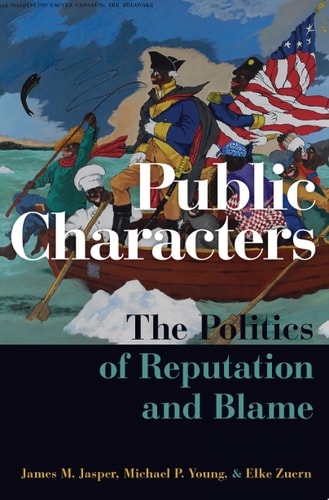
Public Characters: The Politics of Reputation and Blame
0
0
As an Amazon Associate and affiliate partner, Menrva Books earns from qualifying purchases. Learn more
Author Description
Heroes, villains, victims, and minions are more important than ever before in our politics and culture. In the era of television, Twitter, and Facebook, groups and individuals constantly battle over their reputations. One of the best ways to gain power is to persuade others that you are competent, courageous, and benevolent, while your opponents are none of these. Thus, character work consists of more than simple claims of fact; societies build their solidarity and policies out of admiration for heroes but also outrage over villains.Recent political analysis has ignored the great characters of the past in favor of frames, heuristics, codes, and identities. In Public Characters, James M. Jasper, Michael P. Young, and Elke Zuern argue that character, reputation, and images matter in politics, and social life more generally, as they help mobilize people and their passions. First, they focus on the political construction of openly constructed and debated public characters to show how we can allocate praise and blame, identify social problems, cement identities and allegiances, develop policies, and articulate our moral intuitions through them. The authors demonstrate the nuances of characters and their interactions across a range of sources-including Shakespeare, Game of Thrones, Renaissance sculpture, modern comic books, Alexander the Great, and Bernie Madoff-all the while showing how public characters are used in political rhetoric. Finally, they complicate these characters by considering their transformations: when victims manage to become heroes and the way traditional moral characters have evolved over time to correspond with what different cultures admire, detest, or pity.This rich, detailed, and wide-ranging analysis of personal images and reputation marks a timely and crucial contribution for sociologists and political scientists concerned with the cultural dimensions of political life.
Menrva's Summary
THE THESIS
This book investigates how the construction of public characters—heroes, villains, victims, and minions—functions as a primary mechanism for mobilizing political passions and shaping social policy. The authors, James M. Jasper, Michael P. Young, and Elke Zuern, utilize a multidisciplinary framework to argue that reputation and character images are not merely peripheral to political discourse but are central to how societies allocate praise, blame, and moral intuition. By synthesizing cultural analysis with political theory, they demonstrate how these constructed figures serve as essential tools for building solidarity and articulating collective values.
THE SCOPE MAP
What You Will Find
- Analysis of the political construction of public characters in media and historical contexts.
- Theoretical frameworks for understanding how character transformations occur, such as the shift from victim to hero.
- Examination of the role of moral intuition in political rhetoric and policy development.
Scope Limits
- The text focuses primarily on the cultural and political dimensions of reputation rather than providing a quantitative analysis of electoral outcomes.
- It does not offer a prescriptive guide for individual reputation management, focusing instead on macro-level social and political phenomena.
THE AUTHORITY PERSPECTIVE
Scholars in sociology and political science view this work as a significant contribution to the cultural study of political life. Readers frequently note the academic density of the prose, which effectively bridges historical examples with contemporary media analysis to provide a robust theoretical foundation.
Page Count:
320
Publication Date:
2020-01-03
Publisher:
Oxford University Press
ISBN-10:
0190050047
ISBN-13:
9780190050047
Politics
Philosophy
Social Sciences - Social Sciences - Folklore & Mythology
Social Science
New Used & Rental Textbooks
Political
Cultural
Introduction to Human Communication
Comparative
Systems Theory
Politics & Government
Communication Studies
General
Sociology
Anthropology
Community Tags
Similar Books









Reader Comments
Share Your Thoughts
No comments yet. Be the first to share your thoughts!