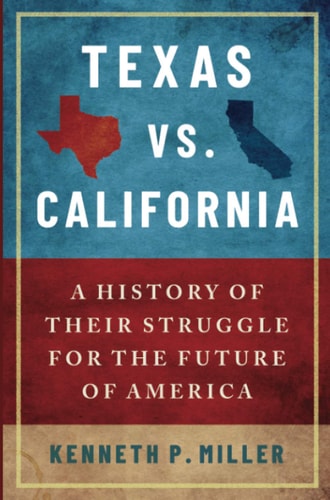
Texas vs. California: A History of Their Struggle for the Future of America: A History of Their Struggle for the Future of America
0
0
As an Amazon Associate and affiliate partner, Menrva Books earns from qualifying purchases. Learn more
Author Description
Texas and California are the leaders of Red and Blue America. As the nation has polarized, its most populous and economically powerful states have taken charge of the opposing camps. These states now advance sharply contrasting political and policy agendas and view themselves as competitors for control of the nation's future. Kenneth P. Miller provides a detailed account of the rivalry's emergence, present state, and possible future. First, he explores why, despite their many similarities, the two states have become so deeply divided. As he shows, they experienced critical differences in their origins and in their later demographic, economic, cultural, and political development. Second, he describes how Texas and California have constructed opposing, comprehensive policy models--one conservative, the other progressive. Miller highlights the states' contrasting policies in five areas--tax, labor, energy and environment, poverty, and social issues--and also shows how Texas and California have led the red and blue state blocs in seeking to influence federal policy in these areas. The book concludes by assessing two models' strengths, vulnerabilities, and future prospects. The rivalry between the two states will likely continue for the foreseeable future, because California will surely stay blue and Texas will likely remain red. The challenge for the two states, and for the nation as a whole, is to view the competition in a positive light and turn it to productive ends. Exploring one of the primary rifts in American politics, Texas vs. California sheds light on virtually every aspect of the country's political system.
Menrva's Summary
THE THESIS
This book investigates the historical, demographic, and political divergence between Texas and California to determine how these states have become the primary ideological anchors of modern American polarization. Kenneth P. Miller, a professor of government, utilizes a comparative political framework to analyze how these two economic powerhouses developed distinct policy models. By examining the structural differences in their origins and subsequent development, Miller argues that the states function as competing laboratories for conservative and progressive governance in the United States.
THE SCOPE MAP
What You Will Find
- Comparative analysis of tax, labor, energy, environmental, and social policy frameworks.
- Historical overview of demographic and cultural shifts in both states.
- Assessment of how state-level policies influence federal legislative agendas.
Scope Limits
- The text does not provide a comprehensive history of every state in the union, focusing strictly on the Texas-California binary.
- It does not offer a predictive model for future election outcomes beyond the general observation of partisan stability.
THE AUTHORITY PERSPECTIVE
Experts and political analysts frequently cite this work as a balanced, data-driven examination of the structural roots of American political polarization. Readers often note that the prose is accessible to non-specialists while maintaining the academic rigor necessary for understanding complex state-level policy dynamics.
Page Count:
384
Publication Date:
2020-08-12
Publisher:
Oxford University Press
ISBN-10:
0190077379
ISBN-13:
9780190077372
Politics
History
New Used & Rental Textbooks
Cultural
American History
Anthropology
Government
Politics & Government
Americas
Law
Sociology
United States
Systems Theory
Public Policy
Community Tags
Similar Books