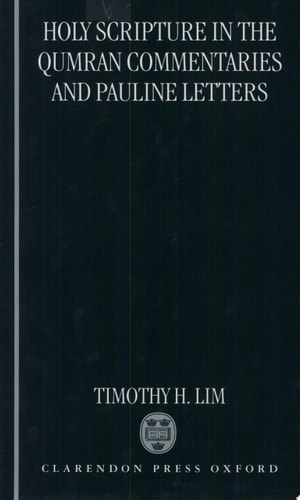
Holy Scripture in the Qumran Commentaries and Pauline Letters
0
0
As an Amazon Associate and affiliate partner, Menrva Books earns from qualifying purchases. Learn more
Author Description
Lim examines scriptural interpretations found in the scrolls excavated from the caves of Qumran, arguably the greatest manuscript discovery in Palestine of the twentieth century. What was the ancient interpreters' attitude to the biblical texts? Did they consider them "sacred" in the sense that the words were the inviolable utterances of God? Or did they modify and adapt them for their own purposes? After fifty years of intensive research it must be asked just how these scrolls shaped the study of Bible interpretation in the Second Temple Period.
Menrva's Summary
THE THESIS
This book investigates the nature of scriptural authority and interpretation within the Qumran community and the Pauline epistles. Timothy H. Lim, a scholar of Dead Sea Scrolls and Second Temple Judaism, utilizes textual analysis of the Qumran scrolls to determine whether ancient interpreters viewed biblical texts as inviolable divine utterances or as flexible documents subject to adaptation. The work evaluates how these findings have fundamentally altered the academic understanding of Bible interpretation during the Second Temple Period.
THE SCOPE MAP
What You Will Find
- Comparative analysis of Qumran pesharim and Pauline hermeneutics
- Examination of the concept of 'sacred' text in antiquity
- Evaluation of manuscript evidence from the Qumran caves
- Historical assessment of Second Temple period interpretive traditions
THE AUTHORITY PERSPECTIVE
Scholars recognize this work as a significant contribution to the study of early Jewish and Christian hermeneutics. Experts frequently highlight the text for its rigorous academic approach to the intersection of Qumran studies and New Testament scholarship.
Page Count:
240
Publication Date:
1997-12-04
Publisher:
Clarendon Press
ISBN-10:
019826206X
ISBN-13:
9780198262060
Religion
History
Archaeology
Theology