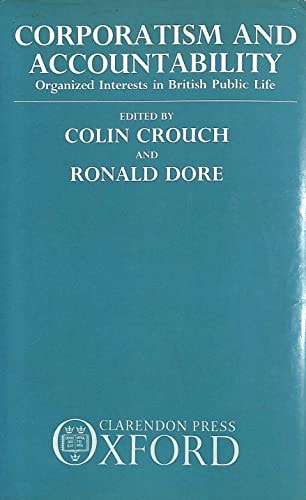
Corporatism and Accountability: Organized Interests in British Public Life
0
0
As an Amazon Associate and affiliate partner, Menrva Books earns from qualifying purchases. Learn more
Author Description
During the 1970s, organized interests increasingly became involved in lobbying and advising the British government, often even administering public services. Known as "corporatism," this phenomenon involved professional organizations, trade associations, charities, and single-interest pressure groups, and was frequently the object of public hostility. Although by the 1980s, corporatism seemed to have been repudiated, evidence of corporatism continues. The book is the result of a study undertaken by the Social Science Research Council to investigate the accountability of the organizations and to determine if corporatism threatens parliamentary government.
Menrva's Summary
THE THESIS
This work investigates whether the rise of organized interest groups in British public life, a phenomenon termed corporatism, undermines the traditional mechanisms of parliamentary accountability. Authors Colin Crouch and Ronald Dore utilize findings from a study commissioned by the Social Science Research Council to analyze how professional organizations, trade associations, and pressure groups integrated into government administration during the 1970s. The text evaluates the tension between these non-elected bodies and democratic governance, questioning the long-term implications of their influence on public service delivery.
THE SCOPE MAP
What You Will Find
- Analysis of the 1970s British political landscape and the expansion of interest group lobbying.
- Examination of the administrative roles assumed by charities, trade associations, and professional bodies.
- Case studies assessing the transparency and accountability of non-governmental organizations in public service.
- Evaluation of the conflict between corporatist structures and parliamentary sovereignty.
THE AUTHORITY PERSPECTIVE
Experts recognize this text as a foundational analysis of the corporatist era in British politics. Scholars frequently cite the book for its detailed examination of the structural challenges posed by organized interests to democratic oversight.
Page Count:
312
Publication Date:
1990-05-31
Publisher:
Oxford University Press
ISBN-10:
0198275900
ISBN-13:
9780198275909
Sociology
Government
British History
Public Policy
Community Tags
Similar Books