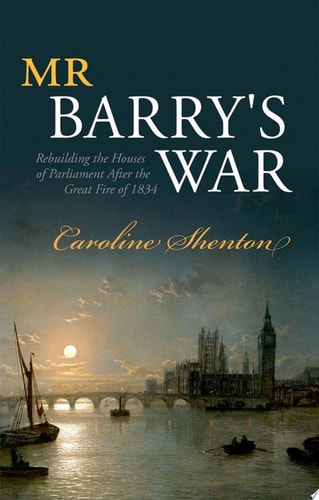
Mr Barry's War
0
0
As an Amazon Associate and affiliate partner, Menrva Books earns from qualifying purchases. Learn more
Author Description
When The Brilliant Classical Architect Charles Barry Won The Competition To Build A New, Gothic, Houses Of Parliament In London He Thought It Was The Chance Of A Lifetime. It Swiftly Turned Into The Most Nightmarish Building Programme Of The Century. From The Beginning, Its Design, Construction And Decoration Were A Battlefield. The Practical And Political Forces Ranged Against Him Were Immense. The New Palace Of Westminster Had To Be Built On Acres Of Unstable Quicksand, While The Lords And Commons Carried On Their Work As Usual. Its River Frontage, A Quarter Of A Mile Long, Needed To Be Constructed In The Treacherous Currents Of The Thames. Its Towers Were So Gigantic They Required Feats Of Civil Engineering And Building Technology Never Used Before. And The Interior Demanded Spectacular New Gothic Features Not Seen Since The Middle Ages. Rallying The Genius Of His Collaborator Pugin; Flanking The Mad Schemes Of A Host Of Crackpot Inventors, Ignorant Busybodies, And Hostile Politicians; Attacking Strikes, Sewage And Cholera; Charging Forward Three Times Over Budget And Massively Behind Schedule, It Took Twenty-five Years For Barry To Achieve Victory With His 'great Work' In The Face Of Overwhelming Odds, And At Great Personal Cost. Mr Barry's War Takes Up Where Its Prize-winning Prequel The Day Parliament Burned Down Left Off, Telling The Story Of How The Greatest Building Programme In Britain For Centuries Produced The World's Most Famous Secular Cathedral To Democracy.
Menrva's Summary
THE THESIS
How did the architect Charles Barry navigate the immense political, technical, and environmental obstacles required to construct the new Palace of Westminster? Caroline Shenton, an archivist and historian, utilizes primary source documentation and architectural records to detail the twenty-five-year struggle to complete this landmark project. She argues that the building's creation was a grueling, high-stakes conflict against bureaucratic incompetence, engineering limitations, and personal exhaustion.
THE SCOPE MAP
What You Will Find
- Detailed account of the construction of the Palace of Westminster from the 1830s to the 1860s.
- Analysis of the collaborative relationship between Charles Barry and A.W.N. Pugin.
- Examination of 19th-century civil engineering challenges, including foundation work on the Thames.
- Documentation of political interference and budgetary crises.
Scope Limits
- The book does not provide a comprehensive biography of Charles Barry outside of his work on the Parliament buildings.
- It does not offer a technical manual on Gothic Revival architectural styles.
THE AUTHORITY PERSPECTIVE
Historians and critics frequently commend the book for its meticulous research and ability to transform complex architectural history into a compelling narrative. Experts highlight the text as a definitive account of the logistical and political pressures inherent in Victorian-era public works projects.
Page Count:
360
Publication Date:
2016-01-01
Publisher:
Oxford University Press
ISBN-10:
0191016977
ISBN-13:
9780191016974
Non-Fiction
Architecture
History
Biography
19th Century
British History
Community Tags
Similar Books