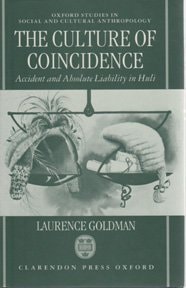
The Culture of Coincidence: Accident and Absolute Liability in Huli
Author Description
Is the concept of accident purely a creation of Western judicial processes? In this innovative study, Goldman examines the ground between law, linguistics, and anthropology to provide the first full-length ethnography on the grammar and pragmatics of the rarely acknowledged or researched topic of accident. Using transcript case data from the Huli people of Papua New Guinea, Goldman explores the linguistic encoding of intentionality, causality, responsibility, and control to show how actors dispute in volitional (murder) or non-volitional (coincidence) idioms. Dr Goldman concludes that, with regard to the concept of accident, Western and non-Western juristic ideologies exhibit startling similarities; his study has important implications for the way we describe the world views of other cultures.
Menrva's Summary
THE THESIS
This study investigates whether the concept of accident is a unique product of Western judicial systems or a universal human cognitive framework. Laurence Goldman, an expert in social and cultural anthropology, utilizes extensive ethnographic fieldwork and linguistic analysis to examine how the Huli people of Papua New Guinea conceptualize causality and responsibility. By analyzing transcript case data, the author argues that non-Western societies possess sophisticated legal ideologies regarding non-volitional events that mirror Western notions of absolute liability.
THE SCOPE MAP
What You Will Find
- Linguistic analysis of intentionality and causality in Huli discourse
- Comparative legal framework between Western and non-Western judicial ideologies
- Primary source transcript data from Huli dispute resolution cases
- Examination of the pragmatics of accident and non-volitional action
THE AUTHORITY PERSPECTIVE
Scholars in the field of legal anthropology recognize this work as a foundational text for understanding how non-Western cultures categorize liability. Readers frequently note the academic density of the prose, which effectively bridges the gap between linguistic theory and ethnographic practice.
Page Count:
464
Publication Date:
1993-04-08
Publisher:
Oxford University Press
ISBN-10:
019827873X
ISBN-13:
9780198278733
Legal Studies
Accident Law
Anthropology
Language And Culture
Ethnography
Social Science
Linguistics
Community Tags
Similar Books