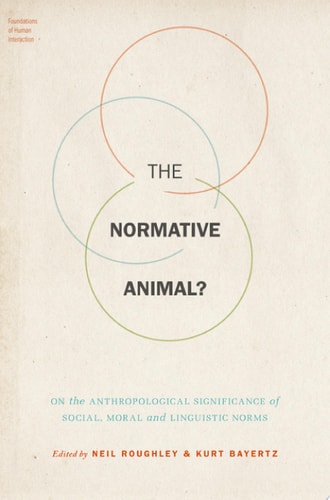
The Normative Animal?: On the Anthropological Significance of Social, Moral, and Linguistic Norms
0
0
As an Amazon Associate and affiliate partner, Menrva Books earns from qualifying purchases. Learn more
Author Description
It is often claimed that humans are rational, linguistic, cultural, or moral creatures. What these characterizations may all have in common is the more fundamental claim that humans are normative animals, in the sense that they are creatures whose lives are structured at a fundamental level by their relationships to norms. The various capacities singled out by discussion of rational, linguistic, cultural, or moral animals might then all essentially involve an orientation to obligations, permissions and prohibitions. And, if this is so, then perhaps it is a basic susceptibility, or proclivity to normative or deontic regulation of thought and behavior that enables humans to develop the various specific features of their life form.This volume of new essays investigates the claim that humans are essentially normative animals in this sense. The contributors do so by looking at the nature and relations of three types of norms, or putative norms-social, moral, and linguistic-and asking whether they might all be different expressions of one basic structure unique to humankind. These questions are posed by philosophers, primatologists, behavioral biologists, psychologists, linguists, and cultural anthropologists, who have collaborated on this topic for many years. The contributors are committed to the idea that understanding normativity is a two-way process, involving a close interaction between conceptual clarification and empirical research.
Menrva's Summary
THE THESIS
This volume investigates the foundational hypothesis that humans are uniquely defined as 'normative animals' whose existence is fundamentally structured by social, moral, and linguistic norms. The editors, Kurt Bayertz and Neil Roughley, curate a collection of essays that bridge the gap between conceptual philosophical inquiry and empirical research. By examining the interplay between deontic regulation and human behavior, the contributors argue that a susceptibility to norms may be the primary mechanism enabling the development of complex human life forms.
THE SCOPE MAP
What You Will Find
- Comparative analysis of social, moral, and linguistic normativity.
- Interdisciplinary frameworks integrating philosophy, primatology, and behavioral biology.
- Methodological approaches emphasizing the synthesis of conceptual clarification and empirical data.
Scope Limits
- The text does not provide a comprehensive history of normative ethics.
- It does not focus on individual psychological development outside of the broader evolutionary and anthropological context.
THE AUTHORITY PERSPECTIVE
Experts identify this collection as a rigorous interdisciplinary resource for scholars interested in the intersection of biology and philosophy. Readers frequently note the academic density of the prose, which requires a foundational understanding of both normative theory and evolutionary science.
Page Count:
390
Publication Date:
2019-01-01
Publisher:
Oxford University Press
ISBN-10:
0190846488
ISBN-13:
9780190846480
Philosophy
Linguistics
Ethics
Social Norms
English
Cultural Anthropology
Anthropology
Social Science
English & College Success
Evolutionary Biology
Community Tags
Similar Books