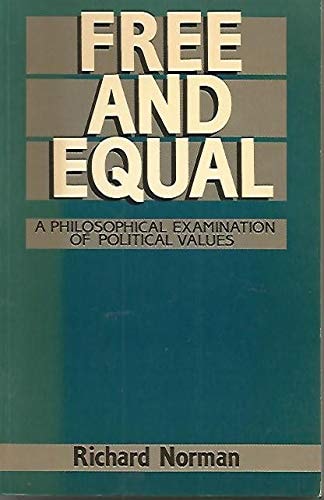
Free and Equal: A Philosophical Examination of Political Values
0
0
As an Amazon Associate and affiliate partner, Menrva Books earns from qualifying purchases. Learn more
Author Description
The concepts of freedom and equality lie at the heart of much contemporary political debate. But how, exactly, are these concepts to be understood? And do they really represent desirable political values? Norman begins from the premise that freedom and equality are rooted in human experience, and thus have a real and objective content. He then argues that the attempt to clarify these concepts is therefore not just a matter of idle philosophical speculation, but also a matter of practical politics, for the philosophical conclusions we reach also have important implications for the day-to-day world of political action. Touching on the work of such influential thinkers as John Stuart Mill, Berlin, Hayek, Nozick, Rawls, and Williams, this book serves as a valuable introduction to the central issues in political philosophy.
Menrva's Summary
THE THESIS
This book investigates the conceptual foundations of freedom and equality to determine their validity and practical application within contemporary political discourse. Richard O. C. Norman approaches these values as objective phenomena rooted in human experience rather than abstract ideals. By synthesizing historical and contemporary philosophical arguments, the author demonstrates how theoretical definitions directly influence the structure and outcomes of real-world political systems.
THE SCOPE MAP
What You Will Find
- Analysis of the conceptual definitions of freedom and equality.
- Comparative study of political thinkers including John Stuart Mill, Isaiah Berlin, Friedrich Hayek, Robert Nozick, John Rawls, and Bernard Williams.
- Examination of the intersection between philosophical theory and practical political action.
- Evaluation of the objective content of political values based on human experience.
THE AUTHORITY PERSPECTIVE
Scholars and students of political theory frequently cite this work as a clear and accessible introduction to the complexities of liberal political philosophy. Experts highlight the book's ability to bridge the gap between abstract academic debate and the tangible realities of political governance.
Page Count:
192
Publication Date:
1987-05-28
Publisher:
Oxford University Press
ISBN-10:
0198275269
ISBN-13:
9780198275268
Philosophy
Non-Fiction
Political Philosophy
Ethics
Community Tags
Similar Books