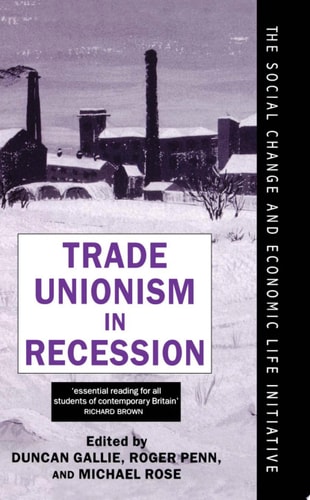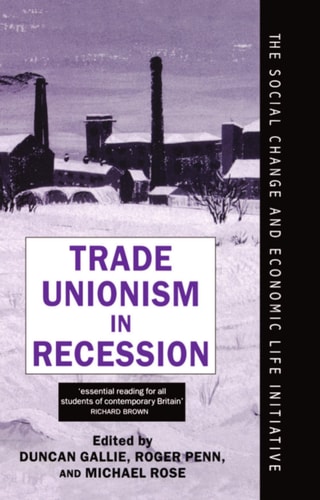
Trade Unionism in Recession
0
0
As an Amazon Associate and affiliate partner, Menrva Books earns from qualifying purchases. Learn more
Author Description
During the 1980s, British trade unionism confronted its greatest challenge, and suffered its greatest reverses, since the inter-war period. After a decade of rapid growth, the unions experienced a steep decline in membership, and a virtual marginalization in national political affairs. This book addresses a number of fundamental questions raised by the record of these years, including the reasons for membership loss and the steps the unions took in reaction to the membership problem. It also looks at whether this period can be seen as making a fundamental break with the past, or whether the past decade has been but a temporary recession and the future can still see a revived movement.
Menrva's Summary
THE THESIS
This book investigates the structural and political factors that precipitated the decline of British trade unionism during the 1980s. The authors, Duncan Gallie, Michael Rose, and Roger Penn, utilize data from the Social Change and Economic Life Initiative to analyze the intersection of economic recession and labor organization. They evaluate whether the membership losses of the decade represented a permanent shift in the industrial landscape or a cyclical downturn in union influence.
THE SCOPE MAP
What You Will Find
- Analysis of British trade union membership trends during the 1980s
- Examination of the political marginalization of labor organizations
- Empirical data regarding industrial relations and economic shifts
- Comparative assessment of historical continuity versus structural change
THE AUTHORITY PERSPECTIVE
Experts recognize this work as a significant contribution to the study of industrial relations during a pivotal decade in British history. Readers frequently note the academic density of the prose and the rigorous reliance on empirical data to support the authors' conclusions.
Page Count:
384
Publication Date:
1996-07-25
Publisher:
Oxford University Press
ISBN-10:
0198279205
ISBN-13:
9780198279204
Economics
Labor unions
Labor history
Sociology
British History